
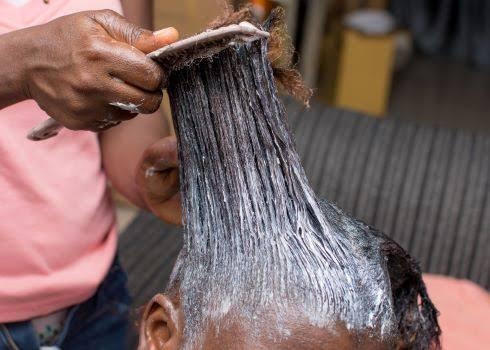
Damage is rarely one dramatic appointment. It is a short list of ordinary errors, repeated. So if you keep asking, “Why is my relaxed hair breaking?” even after spending good money on hair products, the answer is probably on this list. These are the main relaxer breakage causes, ranked by how often they show up: overlap, leaving the relaxer on too long, the wrong strength, incomplete neutralising, and pulling at your hair between retouches. Each one comes with how it damages your hair, what to check for on your own head, and what to do about it.
The Damage Almost Always Starts in One of Five Places
To see why relaxer damages hair, start with what it does: it permanently changes the structure of every strand, so there is very little room for error. Some causes of relaxer damage happen in the salon, others at home in the weeks after.
1. Overlapping Onto Already-Relaxed Hair
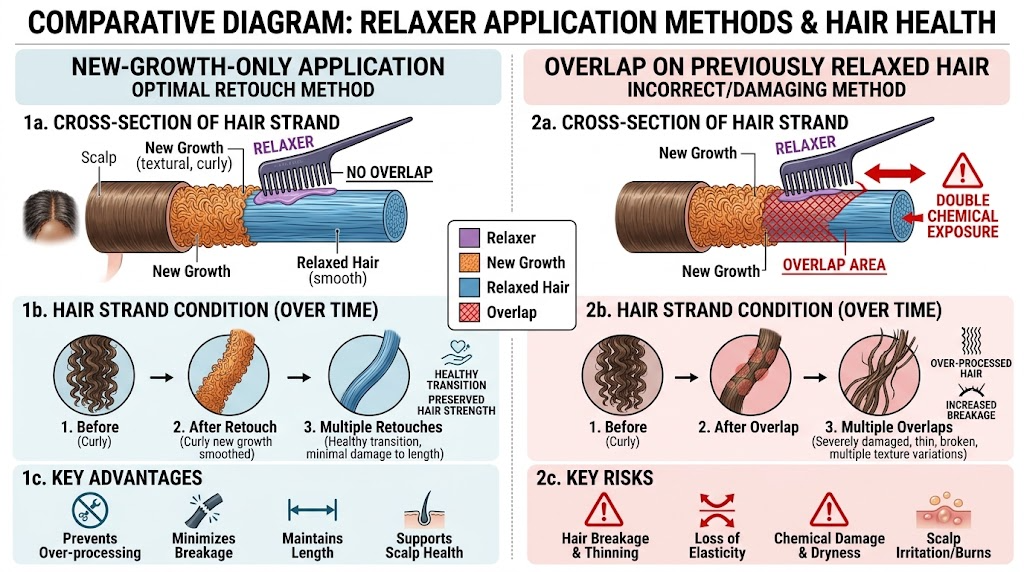
Relaxer overlap takes the number one spot because it is the most common mistake and the easiest to avoid. A retouch is for new growth only. If the cream touches hair that was already relaxed, that hair is broken down again.
- Mechanism: Overlap breaks down the hair’s protein structure a second time. Do it at every retouch, and the hair keeps getting thinner and weaker until it snaps.
- Symptom: Hair that feels mushy when wet, or breaks in the midshaft, a few inches below your new growth.
- Fix: Apply to new growth only. Section your hair neatly with a tail comb, or go to a hairdresser who will not rush.
2. Leaving It On Past the Time
Some hairdressers will tell you to leave it a little longer for bone-straight hair. Please do not agree. It does not work that way.
- Mechanism: Once the maximum time is up, the job is done. Anything after that eats into the inside of the hair and burns the scalp.
- Symptom: Relaxer burn damage shows as a stinging scalp, scabs after a retouch, and thinning all over. If you have open sores or a burn that is not healing, see a doctor.
- Fix: Set a timer on your phone and follow the start point in the product instructions. Rinse when it goes off, even if the hair is not as straight as you wanted. If you use MegaGrowth Relaxer, stick to the timing for your hair type.
3. Choosing a Strength the Hair Does Not Need
Mild is for fine or already-treated hair, regular is for medium hair, and super is only for coarse, resistant hair. Some people ask for super because they believe regular will not work on their hair.
- Mechanism: A stronger relaxer carries more active chemical, and fine or medium hair cannot handle that.
- Symptom: Heavy shedding after your first wash, hair that goes limp and will not hold a style, and a scalp that stings badly even though you kept to the time.
- Fix: Match the strength to your hair texture. If you are not sure, start milder and ask your hairdresser. With MegaGrowth Relaxer or any other brand, read the strength guide on the pack first.
4. Incomplete Neutralising
Many people rinse, feel it is done, and move on. Rinsing is not enough. The relaxer has to be neutralised.
- Mechanism: Neutralising shampoo brings the hair’s pH back down and stops the relaxer from processing. Miss a spot and the residue stays on your hair, still doing damage.
- Symptom: Breakage that continues for weeks after a retouch that was timed and applied correctly, plus sore patches on the scalp.
- Fix: Rinse very well, then wash with the neutralising shampoo as many times as its instructions say. If yours has a colour indicator, wait for it to show before your final rinse.
5. Tension and Manipulation Between Retouches
Sometimes the retouch goes perfectly and your styling finishes the job.
- Mechanism: Relaxed hair is weaker than natural hair. Tight ponytails, tight braids, and weave-ons or wigs that pull at the hairline put a lot of strain on the roots.
- Symptom: Thinning edges, small bald patches around the hairline, and heavy shedding when you take down a tight style.
- Fix: Go easy after a retouch and skip tight styles for at least two weeks. Between retouches, keep braids and weave-ons loose at the edges, and take a style down if it hurts.
The Line of Demarcation, and Why It Snaps First
The line of demarcation is the point where your relaxed hair meets your new growth. The two parts have different strength and stretch, so all the stress gathers at that one spot. Comb roughly or pull, and that is where the hair snaps first. Detangle gently, starting from the ends and working up, and keep relaxer off that spot at every retouch.
How to Tell Over-Processing From Under-Conditioning
Over-processed hair and moisture-starved hair can feel alike in your hand, but they need opposite treatment. Protein helps one and makes the other worse, so get it right before you buy anything.
Pick a strand from the middle of your head, not one that is already broken. Stretch it gently when wet. Healthy hair stretches a little and springs back. Then check how your hair feels when it is dry.
| Check | Over-processed hair | Moisture-starved hair |
| Wet feel | Limp, stringy, mushy | Rough, tangles easily |
| Wet stretch | Stretches a lot, does not spring back | Stretches very little |
| Dry feel | Weak, no bounce | Dull, stiff, snaps easily |
| What helps | Protein treatment | Moisture and gentle conditioning |
| What to avoid | Moisture treatments alone | Protein |

If you see both signs, or you cannot tell, see a hairdresser before you use any protein treatment.
What Damage Can and Cannot Be Repaired
Split ends do not fuse back together, whatever the label on the bottle says. Severely over-processed hair does not come back either. The only real fix for that hair is to trim it off bit by bit as healthy new growth comes in.
Conditioning can improve how your hair feels and reduce further loss. MegaGrowth Damage Protection and Breakfree Leave-In Strengthener are there to limit further breakage while you grow out the damaged hair. They will not reverse anything, so use them to hold on to the length you still have.
FAQs
What causes most relaxer damage?
The most common cause of relaxer damage is overlap, which is when relaxer touches hair that was already relaxed. That hair gets broken down twice, and repeating it at every retouch weakens it until it snaps.
How do I know if my hair is over-processed?
Over-processed hair feels limp and stringy when wet. If you gently stretch a wet strand and it stretches like a weak rubber band without springing back, the hair has been overworked. Healthy hair stretches a little and returns to shape.
Can relaxer damage be repaired?
Not fully. Split ends and severely over-processed hair have to be cut off. Strengthening treatments can limit further breakage and improve how your hair feels while healthy new growth comes in.