
How to beat the rewards system
As someone who has been working in this crowdfunding space for quite some time, I have had the opportunity to have incredible conversations with people who run crowdfunding platforms and people who run campaigns on crowdfunding platforms. As you can imagine, the information you gain from both sides of the coin, while different, is necessary for a complete understanding of the crowdfunding scene. Before I decided on exactly what I wanted Do it Now Now to be, and the kind of support we would need to offer our campaigns, I did a lot of research into what it takes to run a successful campaign and what support campaign founders need. Let’s talk about perks/rewards Yes! You got the money, congratulations! But now, you have to deal with sending everyone that pledged an amount of money to you, the things you promised you would give them. If you have raised $23K and you have 380 backers who have each donated between $10 and $1000, you are going to have to gift 380 people a gift corresponding to the amount they donated. That means, you are going to have to design or purchase the gift and send it to their individual addresses. To some of us, this seems pretty straightforward. However, for people like myself who need to break stuff down, consider this. What is your donation percentage? The first thing to consider when deciding which perks you are going provide to your donors, is how much of the donation is going to go to perks. Most platforms offer a 5% (or more) commission on the amount raised. After that, they add the transaction fees (usually between 3 and 4%). The problem with pledges, is that not everyone has the money in their account when it is time to collect. Factor in the cost of failed pledges. We suggest you factor in another 2% to cover this. So, before you factor in perks at all, you have just paid out 10% of the amount raised on each donation. So far, on each $100, you are making $90. Not bad. What is your attraction percentage? Now, how much money do you want to spend to attract someone to donate to your campaign? This includes any kind of advertising (Facebook, twitter, Instagram etc.) you want to use. We don’t actually suggest you pay a ridiculous amount for advertising a campaign. Say you spend 50c on each $10 donation, that isn’t too bad. So far, on each $100, you are making $85. Not bad. What is your perk percentage? How much do you value your donor, in each donation bracket? Think about this purely monetarily. Your perk percentage reflects how much of the donation you want to spend on the physical or non-physical perks, the shipping of the physical perks, the design costs, etc. We suggest as an individual campaign, you spend no more than 15% of your raised amount on perks. There are different rules, depending on the type of campaign you are running. If you already have a product you are trying to sell, and you have a RRP, then by all means use your existing merchandise! You have already paid for it, and if you are making a small mark-up on the cost-price of your merchandise you are doing well. However, if you do not have existing merchandise and you actually need to make some money to create merchandise, this 15% maximum budget is for you. The 15% includes the physical items, and the packaging and shipping of those items. Note that with the state of most platforms, people expect a lot as a reward. We suggest you get really creative so that you don’t end up spending 50% of your raised amount on perks (trust me, it happens!). You are now at $70 for every $100. Not bad. Keep on budget and you will get a good amount back! Make sure you factor in the quantity of each perk you want to offer. What will your community actually donate? Are you surrounded by $10 givers, or $100 givers? What do you think your $100 will want to receive? Try talking to your community. If you make them a part of your decision making process, they are much more likely to respond to your campaign. What is your administration cost? Think about your opportunity cost. How much time are you going to spend on the post-campaign administration? How much time are you going to spend on marketing and organising your campaign? Most campaigns take 10 hours a week to run, and most campaigns run for 8 weeks. Post-campaign administration is about 3 hours each workday for a month (approx. 60 hours). Factor in a salary that makes sense for whoever is going to be dealing with this part of your campaign. You are looking at 140 hours at an average wage of $5/hour; $700. Factor in 3% of your fundraising amount as a guide, if you don’t want to have strict time/cost constraints. These estimations depend on the number of backers and the type of perks you have —the more personalised the perks, the longer it is going to take to organise properly. It is not impossible to do this well. There are actually a number of print and ship on demand platforms that you can look up. There are also a number of crowdfunding support companies that handle all of this for you. They usually charge between $3-5 per physical item for shipping and handling post-campaign. If you plan and budget carefully, and you do as much of the work yourself and try to use as much readily available merchandise as possible you could be at $67 for each $100 donation post-campaign. Not bad at all. There are benefits to donation/reward based crowdfunding, and there are obvious benefits to no-reward donation based crowdfunding. You need to think about what type of crowdfunding best suits what you are trying to do. Merchandise based campaigns with ready merchandise should go for
Irene Charnley: We women will lead fundamental change on our continent #SheHiveJoburg
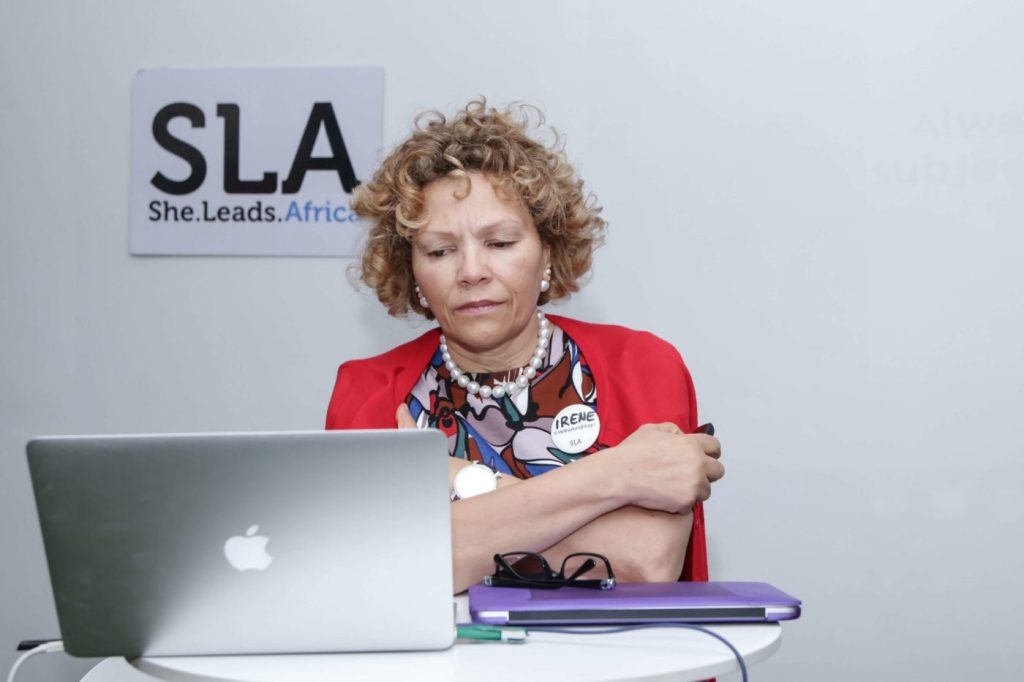
[bctt tweet=”Have the conviction & fortitude to put forth your ideas – Irene Charnley #SheHiveJoburg” username=”SheLeadsAfrica”] Irene Charnley is an ex-MTN exec who led the company’s expansion into Nigeria and Iran. She’s also now a telecoms founder whose company, Pan-African, reigns supreme in Nigeria, Uganda, Tanzania and Congo. At #SheHiveJoburg Irene Charnley dazzled the crowd by sharing the key principles she has followed throughout her career to get to where she is today. With a net worth of around $150 million, it was clear to all in the room that Irene knows a thing or two about being a Motherland Mogul. Irene’s key principles to follow if you want to be successful Have some core values and let them guide you The most important relationship you will ever have is with yourself. According to Irene, when it comes to succeeding in business and in life, you have to realize that there is no magic out there, the magic is within you. You must cultivate some core values rooted in integrity, as these will help guide and sustain you on whatever path you choose to follow. Irene shared that her core value is this: everything is possible. There is always a way, it is up to you to find it. She talked about the difficulties she and her partner faced when trying to secure a building for their business. They faced challenges in getting landlords to rent to them. But having this “everything is possible” attitude, they were persistent in knocking on doors till someone finally let them in the building. “What are the core value that drove you to action everyday?”, Irene opened this question to the audience and the awesome ladies of #SheHiveJoburg shared some of the following responses: “I have the power to make everything I want come true”, “Be truthful to yourself and to others”, “Always follow through on your promises”, “Be present in everything that you do, both physically and psychologically”. Irene encouraged everyone in the audience to be true to their values every single day, to forget everyone else and please themselves first, to simply, “Be you!” [bctt tweet=”Irene Charnley’s core value is simple, everything is possible! #SheHiveJoburg” username=”SheLeadsAfrica”] Always aim to be a subject matter expert Irene talked about the importance of working twice as hard as everyone else in the room to become the expert, the one that people turn to when they want an explanation of how things work. This is the only way to stay ahead of the competition and to become comfortable being in a position of power and influence. When you prepare diligently, you’ll begin to see things outside the box and are able to come up with solutions that no one else has thought of yet. At the end of every day, you ought to ask yourself, “What did I learn today that was worth it for me?” My key takeaway from Irene’s wisdom was, “Know that it’s about you, know what your core values are and always be prepared”. [bctt tweet=”The only way to stand ahead of competition is to work twice as hard – Irene Charnley” username=”SheLeadsAfrica”] Business is logic. Business sense is common sense Sometimes what trips most people up on the way to success, especially when it comes to success in business, is that they waste too much time overthinking things. Women especially have the tendency to dwell too long on things. We are afraid to speak up and share our ideas because we feel like someone in the room must have a better one. Irene shared a very important lesson on this topic. After having spent a lot of time in several boardrooms, one thing that became clear was that no one in the room has all the answers. Have the conviction and the fortitude to put forth your ideas, even if they will be shot down or criticized. Use every opportunity as a learning point: ask questions, share your ideas, learn from others. That’s the only way to keep growing. Find voices you trust. Keep them around you Again, as women we have this tendency to want to shoulder all our burdens ourselves and fight and toil to get the answers we need. But Irene, as successful as she is, shared a key insight, “You can’t go through this journey alone. You need to find your angels and let them help you out along the way”. Irene talked about the importance of having mentors to guide you by offering advice and a fresh perspective. Also of importance is being a role model yourself to someone else who is a bit behind you on the same path. And as a sign of putting your money where your mouth is, Irene offered to share her email and phone number with all the ladies in the room. She promised to be available to mentor anyone who felt they could benefit from talking to her. [bctt tweet=”At #SheHiveJoburg Irene Charnley offered to be a mentor. See what else you missed out on” username=”SheLeadsAfrica”] Be a value-add. To everyone. All the time For a minute, stop and think about you. What is it that you bring to the table, to your business, to your community that no one else does? What is it that you do differently that makes you so special? Irene reminded us that we all have gifts that we should be nurturing. It is up to us to bring these gifts with us to every relationship or partnership. We should start to view entrepreneurship as a way to add value to what is already out there. Build sensible relationships, sensitively Last but not least, Irene talked about the important of relationships. Of cultivating the right relationships, with the right people at the right time. On the journey to success, we must strive to do our best to listen and learn, and to truly understand where others are coming from so that we might know how to best serve them. Irene ended her talk on
How to make the switch from consumer to producer
[bctt tweet=”Most of us consumers never think about how we can join the elite community of producers” username=”SheLeadsAfrica”] What are some of the things you consume or do daily? If you are anything like me, there’s a newspaper column that I am obsessed with. It brings out issues that greatly resonate with me. I also feel lost when I don’t have my phone. For you, it could be going out to your favourite bar to get some drinks with friends. Or it could be listening to that great music or watching the latest season of Orange is the New black (well, that’s me again). Absolutely everything we use in life was created by someone. Well, apart from the air we breathe and other gifts of nature. Someone went out of their way to create that video game that you can’t get enough of. Unfortunately, most of us just buy things. We never think about how we can also join the elite community of producers. I mean, wouldn’t it feel good if your name was on a product/service that people value? I am going to show you how to get in touch with your fabulous producer side. First, let’s look at the attitudes that define consumers and producers. The consumer attitude Consumers are passive about their ability to grow, reactive about life and unquestioning of their environment. They take life as it is, conforming to the standards set for them by society (or producers). When it comes to their finances, consumers buy their way to financial scarcity, but that is a topic for another day. Consumers wait for other people to create opportunities for them. The producer attitude A producer is someone who makes a product or service. Producers usually live outside their comfort zones by constantly looking at how to improve the word around them. Producers create their own lives. They believe that their destiny is in their hands and that if something is to be, then it is up to them. They create value for other people. [bctt tweet=”Producers are constantly looking at how to improve the word around them ” username=”SheLeadsAfrica”] Why the producer attitude is superior You might be wondering why I am rambling on and on… “What’s the big deal about this? Why should I even bother to be a producer? Doesn’t the world need both producers and consumers?” You are right, the world needs both producers and consumers, otherwise there would be no one to utilize the resources that we produce and vice versa. The producer is the one who makes things happen. S/he goes above and beyond to create value for others (and for themselves). And in the process she creates a legacy for herself which lives on even when they are gone. Think people like Steve Jobs and Elon Musk who are known for the personal computer revolution and for launching a landmark commercial spacecraft respectively. If you want to create a legacy that is worth writing about, you will have to step into a producer role, giving some kind of value to the world. [bctt tweet=”@Gloriakambedha’s 3 steps to switching from consumer to producer” username=”SheLeadsAfrica”] How to make the switch… So now that you know why it’s important to make the switch, let’s dive straight into how to go about it using these three steps: Step 1: Practice awareness and question every decision Making the switch to a producer starts with acknowledging that everything around you was created by someone who took a chance. See how you can apply your knowledge and skills to create something of value to the world. The more successful producers who get the greatest reward are those who add the greatest value. When you become more aware of your environment, start questioning every decision you make to consume —whether it is to do with your purchases or the way you spend your time or even the information you read. Step 2: Actively process information Every producer needs information. Thankfully, we live in an information age. However, Instead of processing information passively by spending hours online, producers look for way on how this information will change their life. Everyone starts with consuming information but the intention should be to start producing as soon as possible. However, even students don’t have to just be consumers of knowledge. Students can add value through blogging, entrepreneurial efforts, teaching, etc. Step 3: Action Everyone has something to offer the world. Identify what it is you are good at and offer it to the world. It is a good idea to get inspiration through reading blogs, personal development books, listening to podcasts, attending conferences, but the work will still not be done. You have to be willing to sit down and start creating. It does not have to be perfect. All you need is a vision of what you want to create. The Internet has given us the tools for just anyone to be a producer. Use them. If you want to write, you don’t need any approval from an editor, to start your own show, Youtube is available. Do not be passive about making your own unique contribution to the world. Concluding When you first decide to become a producer, you will not see results right away and you might feel like your time is being put to waste. But do not give up. Overtime, your actions will build momentum and this will define the legacy you will leave.
Procrastination: The bad, the ugly, and how to deal with It

[bctt tweet=”You can’t be a #MotherlandMogul if you’re a serial procrastinator, time to break free” username=”SheLeadsAfrica”] Do you always apologize for delayed work? Do you feel guilty that you missed the deadline again, for the umpteenth time? And if you did finish the work, it was at the last minute after scrambling with time? Well, let’s cut to the chase. You are a serial procrastinator who pushes the production of any work forward to the next day, next week, next month, next year and eventually to never, instead of pulling it forward. For that reason, procrastination is the opposite of productivity. Many people are procrastinators, and they do not even know it. Sometimes procrastination can be good. For example, I sometimes have to push forward writing an article because I just don’t have the right word or phrase to start the piece. But once I get the inspiration, I embark on writing and occasionally, I have to type it while on my toes. Do you really need to procrastinate? If you can’t push forward looking good before going out for a date, you shouldn’t hold back writing that proposal that you have been sitting on for the past three months. Today is the time! To make sense of procrastination, its effects and how to deal with it, I caught up with Ken Munyua, a business support and training manager at Talent Recruit Limited in Nairobi, Kenya. According to Mr. Munyua, who is also a psychologist, “Procrastination is the inability to undertake urgent duties with the haste they deserve.” He adds that it could be as a result of a habit — “choosing not to take things seriously and execute them promptly, which later turns into bad behaviour.” “Procrastination is both a behavioural and a psychological issue. It starts as a habit and turns to uncontrollable aspects.” [bctt tweet=”Extensive inactive procrastination can also contribute to lowering one’s self-esteem” username=”SheLeadsAfrica”] Self-loathing? Apart from degenerating into bad behaviour, extensive inactive procrastination can also contribute to lowering one’s self-esteem. How, you ask? Munyua notes that the inability to perform necessary tasks always leads one to be in problem be it in school, at home or in business. “The constant reminder and backlash from the seniors make one feel as if they are victimized or segregated from the others.” What’s more, this can cause you to loathe yourself for not being able to meet individual or collective goals on time. No one wants to feel less of a person for always being late in doing something, and when one does, they may feel unwanted or unloved, leading to a downward trend of one’s self-esteem. Many women in business are caught up in the procrastination web due to a few reasons. Munyua outlined three major reasons why procrastination is common: The wish to be perfect: Some people wait to do work to its best. At the end, they do it in a hurry to the point of not delivering it well. Poor planning: Some business women like to plan work in terms of urgency and importance. Thus, there are delays on the important aspects of work. Others are easily swayed away by distractors. [bctt tweet=”@MaureenMurori sought expert help in this article on overcoming procrastination ” username=”SheLeadsAfrica”] How to overcome procrastination “A habit which grows over time becomes a bad addiction. Do not form it; learn to concentrate on what is your task before any other duty,” advises Munyua. He adds that people should learn to avoid distractions, be they human or technological. Avoid delays: Always live to do what is expected now and not tomorrow! Draw a plan: It is advisable to set priorities and consider the urgency of the work. Write it down on paper: When it is written on paper, work becomes real and demands commitment. Set personal deadlines before the stipulated ones. This ensures that you are always ahead. Reward yourself: Rewarding yourself for achieved goals, motivates you to work harder to achieve more in future. Rewards can be as trivial as ticking an achieved activity, to a chocolate bar or a holiday in Hawaii. The choice is yours. Avoid distractions like social media, and friends who do not share in your vision. Endeavour to learn from those who had the same issues and were able to resolve them. When all is said and done, procrastination can be a symptom of an underlying technical or moral failure. It is important to check and recheck why you need to push work forward. Could it be due to the fact that the work isn’t working for you? If so, you should plan to change the work or your approach to it.
How to deal with career FOMO

[bctt tweet=”The best way to deal with career FOMO is to create your own opportunities” username=”SheLeadsAfrica”] “Cissy just got that job offer with the international company and will soon be moving to start!” “Kathy just got this prestigious scholarship!” “Lena moved to a new company and is now making five times your current salary!” Everyone’s life has turned out perfectly. Well, everyone except you. You feel that you have stayed too long in an underpaid position. If you could turn back the hands of time, you would have taken that internship. You keep thinking that things would have turned out differently if you had pursued other career options. Your days are filled with concern. My dear friend, you are dealing with career FOMO, the fear that you are missing out on great career opportunities. Career FOMO materializes when we feel that our careers are not good enough because of the decisions we have made. Here are some of the ways you can deal with career FOMO that do not involve job hopping. [bctt tweet=”Career FOMO materializes when we feel that our careers are not good enough ” username=”SheLeadsAfrica”] Pursue a passion project A passion project is something you do on your own terms and for nobody else’s satisfaction but your own. It stems from your desire to create. Most of us are in jobs where our creative juices are stifled. If you feel you could use a more creative job, why not put in some time to pursue creative efforts? Whether you choose to paint, sculpt, or write a novel is up to you. Your passion project could be what you need to figure out what you want to do in life. Start a side hustle Your career FOMO could be stemming from not pursuing your entrepreneurial ambitions. Deal with this by starting a side hustle. The advantage of a side hustle is that there is little risk involved. You don’t have to quit your job to start. Extra money anyone? Your side hustle could develop into a full time job with time. [bctt tweet=”Your career FOMO could be stemming from not pursuing your entrepreneurial ambitions” username=”SheLeadsAfrica”] Volunteer If you have passion for giving back to the community but you are not able to do that at your day job, volunteering is a way to fill this void. Consider participating in your employer’s programs if any. If this is not an option, look into creating your own valuable volunteering experiences. Free courses There are lots of free courses you can take up to learn about a field you are interested in. Valuable resources include MOOCS, conferences, podcasts, and webinars. You might find that a field you were so attracted to in the beginning does not seem appealing as you dig deeper. Network Build professional relationships with people who are working in the field you are interested in. Conduct informational interviews and ask as many questions as you can. You will find that people are willing to open up about their fields. The information gained will help you make a decision on whether to pursue your career aspirations in that field. Create your own opportunities The best way to deal with career FOMO is to create your own opportunities. You need to understand that if you want to achieve something in life you will have to work hard to achieve it. Stalking more seemingly successful people on social media will not get you what you want. Regrets about career decisions made in the past will sap your energy. Ask for that job rotation, request to be transferred to another department, volunteer for a work project you might be interested in, have a candid talk with your boss about your career development plans. Do not be passive about your career aspirations. All careers come with their own challenges. Like they say, the grass is not always greener on the other side. The grass is greener where you water it. Shut the world out, choose one thing and relentlessly go after it. So long as you have set reasonable career goals for yourself and you are taking action everyday to improve your personal profile, what everyone else is doing with their lives will not matter any more. Are you experiencing any career FOMO? How are you dealing with it?
10 Things Motherland Moguls would tell their 21 year old self

[bctt tweet=”Keep your head up ladies, so your crown doesn’t fall down” username=”SheLeadsAfrica”] We asked our community members what advice they would have give their 21 year old self. We couldn’t keep all that knowledge locked away in an Instagram post for you to never think about again. We’ve compiled all that collectively wisdom here. The collective knowledge of our SLA community fell into 10 different categories and we’ve broken it down for you. So get your pen out and bookmark this page. You’re welcome. Confidence One of the things that truly makes a Motherland Mogul is that she is confident in herself and her abilities. She doesn’t let small minds and mean words hold her back. Keep your head up ladies, so your crown doesn’t fall down. @Marlidiallo: “1. Don’t conform to the norm. 2. Have confidence in yourself.” @Thelady_sek: “Protect your heart. Protect your mind. Don’t take yourself for granted and care less what people think about your hustle.” @Daramolafeyi: “Believe in the God that you serve, believe you can be and do whatever you decide to be. Stop comparing yourself with others. Be hardworking, Don’t be lazy.” Start TODAY There is no time like the present. Our community wants you to know that you shouldn’t sit on those amazing ideas of yours. Don’t wait till you’re the right age. Don’t wait till you have enough money. Heck, don’t even wait till you graduate. Roll up your sleeves and get to work: now, now. @G_mama1: “That it’s good to start mall. Stop waiting for a big capital to start, start with the little you’ve got.” @Imoheboh: “Start this already! Don’t procrastinate.” @Amazinfarie: “It’s not too late.. You can still make it InshaAllah.” @Ms_dinma_o: “There is no better time to start than now. You have more than you need.” @Nalianyalouise: “Don’t procrastinate” @Lamide_ “Just start” [bctt tweet=”The SLA community wants you to know that you shouldn’t sit on those amazing ideas of yours.” username=”SheLeadsAfrica”] These are the days —give it your all In addition to starting today, your fellow Motherland Moguls want you to go hard! Now in your early 20s is the time to throw your heart and energy into what you do. You likely have fewer commitments & expenses so chase your dreams and chase them tirelessly. @Thealaroro: “This is your season of independence! Maximise it. Do more. See more. Be more.” @Lululingerieng: “Age 17-21 are foundation years. “Suffer then enjoy later,” compromise, have multiple jobs, DON’T just be a student.” @Maa_designz: “Ain’t no time for games darling. Pursue you with all you got. Find that dream. Water it. You would be glad you did.” @Chigozie18: “Take all the risks you want now. Don’t wait till you are 30.” @Vianniey: “Explore the opportunities right before you first… you can’t choose to look outside much later!” [bctt tweet=”Now in your early 20s is the time to throw your heart and energy into what you do” username=”SheLeadsAfrica”] Work ethic Dreams and ideas are great, but you have to be willing and able to put in the work! Make sure you focus on the task at hand and work hard on your priorities. @Lonitagram: “I’m 21, will be 22 next week Saturday…so it’s “never stop dreaming, never stop believing, it’s only a matter of time, never stop planning, she who works her ass off wins, stay in your magic, eventually all things fall into place and let God be God.” @Berugubydeezah: “Stop dreaming and start working.” @Theskinapothecary: “Go harder, stop procrastinating, you can do it.” Your studies & beyond Your studies are very important, but also one day you will graduate. Make sure you are thinking of that end goal. What are you in school for? Don’t just go through the motions and make sure you are also finding ways to skill build outside the classroom. @Tolulopefunsho: “School and studying isn’t everything!! Think entrepreneurship!” @Marymangeni: “Explore and learn as much as you can” @Lululingerieng: “Age 17-21 are foundation years. “Suffer then enjoy later,” compromise, have multiple jobs, DON’T just be a student.” Perseverance We all know why the tortoise whooped the hare in their super famous race. Don’t get lazy. Stay focused and keep working on your goals: every month, every week, and every day. @Bisolaatiba: “You’re almost there, keep moving.” @Alorhhs_chayil: “Keep trusting God, keep working hard, don’t give up your dreams and be consistent.” @Chicest_elle: “You’re on the right path girl. Keep it up!” [bctt tweet=”Stay focused and keep working on your goals: every month, every week, and every day” username=”SheLeadsAfrica”] Well-Being Life is not a sprint. It’s a marathon. So make sure you are taking care of yourself and doing all the things that will ensure you are able to enjoy the fruits of your labour for a long time. Keep yourself physically, mentally, spiritually & emotionally well. @Curlynewbie: “Eat well, sleep well, run and most your issues will be easy to solve with a clear mind and healthy bod.” @Aadidako: “Comparison is the thief of all joy.” @So_samiama: “Don’t sweat it girl.” Everything has its time While you are busy chasing your dreams and taking care of yourself, also realize that some things are out of your control. As long as you are giving your all, and striving to be the best at what you do, everything else will fall into place. @If.e.oma: “Do it…Push through the pain. It’s ok to not get it at a particular time, it will come at the right time.” @Gift_angela_ : “Let tomorrow worry about itself” @Battousai_h: “Relax it’s going to be alright” @Nnigdini: “To my own self, I would’ve said “self take your time, marriage wasn’t the remedy of your tears, pain, sparrow, disappointments, life was just beginning, there is more to life than compromising your life to marriage.” @Mz_danielzzz: “Insecurity isn’t pretty. Be patient and find your own path. Being in a hurry to accelerate your career like your elder ones can ruin you. Enjoy the journey.” [bctt tweet=”As long as you are giving your all, everything else
Twitter Chat with Carol Nyazika: Moving back home as an entrepreneur (Nov. 3)

Thinking of moving back home? Thinking of starting a business? Thinking of moving back home AND starting a business? You’re not alone. There is a growing trend of Africans abroad moving back home and there are resources and organizations like Resource Nigeria and Movemeback that are helping people do just that. Within the group of people moving back home, are also those that are doing so to start a business. Some do it because certain ideas they saw abroad have not yet reached their part of Africa or because the economy of certain African countries are ripe for entrepreneurship, others still do it because they want to give back to their home and they are passionate about the industry they are venturing into. A UK resident who moved back home to Zimbabwe, Carol Nyazika fits into many of these categories. She is the founder of the African Women Awards and the founder Ndanaka, a natural skin care line. Join us Thursday Nov. 3rd for a Twitter chat with Carol Nyazika to discuss the perks and set backs of moving back home and starting a business, or businesses. Follow She Leads Africa on twitter and use the hashtag #SheHiveJoburg to ask your questions and participate in the discussion. Topics that we’ll cover: Deciding whether it is time to move home Knowing if your business idea will live on when you move back home The importance of celebrating African girl magic Balancing two busineses & a 9-5 Twitter chat details Date: Thursday Nov. 3, 2016 Time: 8am NYC // 12pm London // 2pm Harare Location: Follow She Leads Africa on twitter and use the hashtag #SheHiveJoburg Help us spread the word: [bctt tweet=”I’m excited to learn about moving back home to start a business from @CarolNyazika & @SheLeadAfrica. :” via=”no”] Self- motivated, dynamic, hard-working and goal oriented are some of the many characteristics that Carol Nyazika has developed through her few years as a successful social entrepreneur. With a focused mind-set, she has managed to centre her business ventures on the development of women in all aspects of their lives. This has primarily been based on the promotion of the beauty within through business initiatives and independence. Carol has packaged herself as a complete influential brand that reaches people through all mediums of life, whether through the radio, television or print media. Her effort to reach clients through the expansion of her brand is what has made her a rising personality in the Zimbabwean community, at home and the diaspora. Through her popularity in the beauty industry, Carol founded Ndanaka by Carol Nyazika, a lifestyle brand platform that showcases beauty and hair. She then expanded this platform and launched her beauty brand with the same name which covers hair care, skin care and body care products. Her YouTube videos show the simplicity of beauty without breaking the bank with views of over three hundred thousand. She is also Founder of African Women Association, a female empowerment association. AWA is not be a platform that excels in rhetoric but fails in practice; it is invested in making sure that people’s lives are truly changed. This project is highly rated by the experts in the industry. The African Women Awards are under the association and have been hailed as the ‘Oscars of Africa’ by most media outlets. The Awards have been well received by many across the continent and truly appreciated for the impact is has had on many African women. The other platforms under the association include AWA Foundation, AWA Media, AWA Network. Carol continues to break barriers, positively impacting women around her, pushing the boundary and challenging the norm.
Against all odds (bouncing back after a failed business)

I recently experienced a failed business and it would have been devastating if not for my support team. The good thing about failure for a positive minded person (which should be the mind set of an entrepreneur) is the ability to use the experience as a learning process. When a business venture fails there are two most likely reactions from the entrepreneur. You either give up or dive back in again, trying to make it right this time around. From my own experience, here are some helpful tips on bouncing back from a business failure. 1. And the blame lies… A whole lot of things could have gone wrong. The first step is to take an introspective look at your business journey and without been biased. Analyse the venture and pinpoint where things went wrong. You can ask the people who had interactions with your business for their opinions. Be sure to let go of the hurt that comes from failing at a venture. The altruistic ones will prefer to blame themselves and this might be harmful if you cannot get over the blame game. 2. Decide… Next, decide if you are returning to that venture or starting a new venture. This is important as it will determine your next moves. The decision to continue a failed venture will rest solely on you. Consider the reason you started the venture. Was it just a business or a deal with a goal? An ordinary business idea (not that there are ordinary business ideas, but some are conceived based on needs as opposed to those based on passion), is easy to let go of. With this idea, you can venture into a different line of business, responding to another need. However when your idea is part of a dream, it is harder to dump it and move on. 3. Restore This is usually the hardest. If your business was loan funded, it is always a source of grave concern. Many business owners suffer huge financial losses after a failed venture. Although not easy, making efforts to restore/refund loans can give a sense of fulfillment. This is not to say that inability to do so should lead to depression rather a well laid out plan for payment may inspire hope. It is absolutely necessary to avoid any form of self deprecating thoughts. 4. Plan Now that you have decided, begin to make plans in line with your decision. If you have decided to move on. You will need a fresh new idea and plan according to the idea. In the event that you want to continue with your previous idea, make further research using your previous mistakes as key points. Go back to the drawing board. Your drawing board will hold your idea, its concept, theme and any previous mistakes. It is time for a new flow chart which will utilise the information gathered from the research you have done. Tip: If you really need funds at this point, consider crowd funding. 5. Take your time It is tempting to want to dive right into the deep end when you have found the solution or something new. Don’t do this. It’s not advisable jump right in. And no, this is not saying you should procrastinate. On the contrary, take time to set out a pace that will allow you notice changes and progress. 6. Laying the ground work Now you work, and I must add with a vengeance. Going from the drawing board to the work table is literally a huge step. This is where every past lesson is put to the test. 7. Faith Having a strong belief in the success of your venture helps to pad all the hard work you have done. Praying about your moves and asking for directions divinely can go a long way. Also a positive mind set is required. Always. 8. Be patient When you start squatting at the gym, there is a tendency to look at your butt for signs of growth. Disappointment quickly follows when the expected immediate transformation is not seen. Like squats, your business will need time and constant, continuous efforts to grow and begin to show signs of growth. Be patient. Continue to work at it. To avoid working blindly, take constant review of your progress. It may be quarterly or monthly but alway take stock. Mark areas that might need improvement or changes. Make necessary upgrades. Get customer feedback. You cannot know too much. Even after the initial research, always seek expert opinions at every stage. This will serve as a guide along and also a yard stick to measure your progress. In the long run. Your perception of a failed business is vital to your entrepreneurial life. If you develop the habit of not giving up and taking every failure as practice and a lesson, you will find yourself very soon in a successful venture with lots of stories to tell. Remember
Fundi Zwane: It’s critical for artists to be exposed to business

Who says you have to choose between being creative and working in the corporate world? Fundi Zwane believes you can have both. As a Motherland Mogul, Fundi manages to successfully combine two unusual passions; art and the corporate world. Through her Industrial Theatre, Phezulu-Phambili, Fundi translates boring policies into informative theatrical shows. When she’s not running her creative/artistic company, Fundi acts and has appeared on soapies such as Generations. Find out why people in the performing arts should be exposed to business and the one important skill all artists need below. Why do you think people in the performing arts should be exposed to business? I think it is critical for artists to be exposed to business as it helps them navigate spaces beyond the creative world. It is a great arsenal in their “toolbox” when negotiating things like contracts and issues of strategically placing themselves as brands. It also adds enormous value to their package as an artist. Another way it comes in handy is that sometimes, as artists, we go through what we call “dry seasons” when there is not a lot of acting work available. So having a background in business can really assist in coming up with ways to sustain yourself during this period as it encourages thinking out-of-the-box and beyond your comfort zone. How does your Industrial Theatre, Phezulu-Phambili Collective merge both passions seamlessly? Phezulu-Phambili merges the corporate and creative worlds by taking something like a policy or a piece of legislation and presenting it in manner that is “out-of-the-box”. Another component that becomes critical is understanding the audience that you present that piece of Industrial Theatre to. Usually, it is a non-theatre going audience and most times, it’s their first contact with the creative world. So it becomes incumbent on my company to make the experience unforgettable and memorable. Phezulu-Phambili takes what is usually mundane, black and white, full of jargon and brings it to life! That is how we marry the worlds of corporate and creative seamlessly. How have you successfully combined your passions for art and the corporate world? What I mark as success is when Phezulu-Phambili did contracts for BROLL (one of the biggest property realtors in SA) and recently Transnet (one of the biggest parastatals in SA). The way we were able to interpret and communicate their health and safety policies through theatre was, for me, magical. I deem a project a success based on the response we get during and after a performance -and obviously the request for more business. It is always a gratifying feeling and makes all the hours spent combing through a policy and interpreting it through the creative process of writing and rehearsals worth it. I also consider it a success when Phezulu-Phambili manages to go into the corporate space and get people to engage with a policy in a way that is fun and interactive because of the way we present it to them. What keeps you going as a young black South African woman? What keeps me going as a young South African woman in business is an insatiable desire to succeed and leave a legacy. Not only for my daughter but for other young women who have dared to go into business in a country where the economic scales are still so imbalanced. Transformation, especially in the corporate space, is non-existent. I want to be part of the pulse changing the narrative of African woman, a pulse celebrating our glory and showcasing us as the amazing, determined success we are. What also keeps me going is my 3-year-old daughter, Bella-Rose. I’ve always wanted to be a mother that models black excellence to my daughter. Being a single mother in business has NOT been easy. There are times when you feel overwhelmed and want to throwing in the towel for something “easier” seems like the the “better” option. But keeping focused on the goal of leaving a legacy for my daughter and all other women who look up to me keeps me going. My motto is, ” I don’t stop because it gets hard, I stop when the work is finished”. What is one seemingly insurmountable challenge you’ve faced and how did you overcome it? One challenge that is forever present is the issue of capital. Be it to start a big project or to expand as the demand for work grows. This can be a very stressful and sometimes, a seemingly insurmountable challenge. The art of business, I believe, is the relationships you nurture and foster over the years. So in times where money needs to show up for operational purposes and the business coffers are running dry, there are strategic business synergies I have formed with people who are willing to assist. Creating a culture of taking care of each other financially is important. This obviously comes with one having to practice absolute financial integrity. Once our coffers are replenished, we give back what was borrowed to in times of need. You spent 4 years on the soapie Generations, what advice would you give on maintaining business relationships for the long run? I believe maintaining business relationships is absolutely crucial as I’ve mentioned above. Acting on a soapie like Generations really did teach me that. I always advise on maintaining a good working relationship, especially with people you enjoy working with, people who inspire you to do more and people who believe in your vision for success. What business skills do you think an actress must definitely have? As an actress, you MUST have the business skill of negotiating. This, I believe, is really important and makes people take you seriously. Be it negotiating a contract, or negotiating with producers/ writers about a storyline for the character you are playing, it is an important skill. I once witnessed actress Nambitha do this on the set of Generations and I gained such a profound respect for her. Nambitha knew her character in and out and there was a line in the
Twitter Chat with Thokozile Mangwiro: Starting a natural hair business in Africa (Oct. 27th)

All you natural hair ladies out there know that the struggle can be too real. Between trying to find products that work for your hair, to looking for products with organic ingredients. These struggles can be further exasperated when you live on the continent and you want to buy local or you have aunties telling you to go fix your hair. Now put this all in the context of trying to start a natural hair brand and you’ve got quite a complicated recipe on your hands. It’s in these complicated situations where champions are born and Thokozile Mangwiro is one such champion. After being unable to find locally made natural hair products in her native South Africa, she decided to start her own line. Join us Thursday Oct. 27th for a Twitter Chat with Thokozile as she shares how she built her natural hair business, Nilotiqa, in South Africa and her advice for other naturals and budding entrepreneurs. Whether you’re an African natural, a natural hair product junkie or an aspiring entrepreneur in the beauty industry, you don’t want to miss this chat. Follow She Leads Africa on twitter and use the hashtag #SheHiveJoburg to ask your questions and participate in the discussion. Topics that we’ll cover: What it’s like being natural in South Africa The importance of buying localy products How to start a natural hair line, from resources to customers and more Advice for natural hair ladies and apiring entreprenuers Twitter chat details Date: Thursday Oct. 27, 2016 Time: 1pm NYC // 6pm Lagos // 7pm Joburg Location: Follow She Leads Africa on twitter and use the hashtag #SheHiveJoburg About Thokozile Mangwiro It is in growing her own natural hair for the past 15 years that Thokozile Mangwiro found her inspiration to create a natural hair care product line. After going to several salons and an endless search of locally produced products that truly work for afro natural hair, it was clear that there was a HUGE gap in the market for professionally formulated products for natural hair. Thokozile, like many other women, struggled with extremely dry hair. This and the lack of knowledge led to intense research and experimentation of natural ingredients such as Shea butter and avocado oil for skin and hair. After several years of research, formulations and product testing, Thokozile launched Nilotiqa, a line of products that are proudly made with organics, natural and naturally formed ingredients to deeply moisturize and nourish ethnic Hair. Thokozile Mangwiro is an Information Technology Masters graduate from the University of South Africa, with over 8 years’ experience in the database administration, analysis and intelligence industry. She is a wife and mother of two energetic boys, Anesu and Omari. She is born and bred in South Africa, Johannesburg. A budding entrepreneur, she is driven and passionate by empowering and inspiring other women to feel naturally beautiful through products that are made in South Africa, are of the highest quality, are beautiful and luxurious, to showcase to the world.