
She Leads Africa, March 30th, 2026
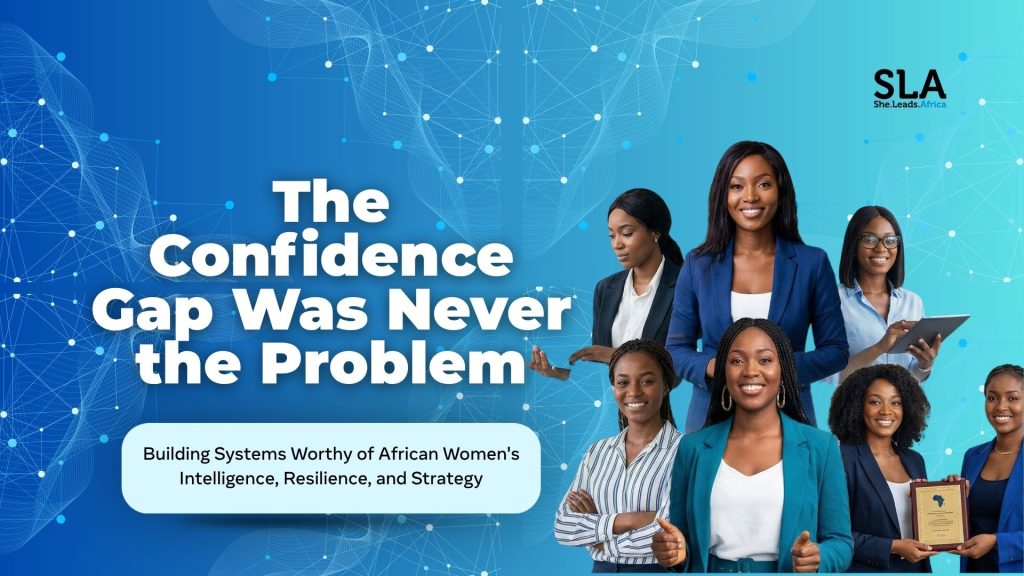
For years, we’ve been told a convenient story: that African women just need more confidence.
Lean in. Speak up. Take your seat at the table.
But after working with thousands of women across industries, countries, and career stages, we can say this plainly:
Confidence is not the problem. And it never was.
At She Leads Africa, we’ve sat in rooms with women who are building businesses from scratch, leading teams under pressure, navigating male-dominated industries, and holding entire families and communities together. These women are not lacking belief in themselves.
What they are navigating—daily—are systems that were never designed with them in mind.
The Myth of the “Confidence Gap”
The idea of a “confidence gap” became popular through leadership discourse that suggested women hold themselves back more than men do. But research paints a more complicated picture.
Studies like those published in the Harvard Business Review show that women often underestimate their readiness for roles compared to men, but that’s not because they are inherently less confident—it’s because they are responding rationally to environments that penalize them differently.
Another body of research from McKinsey’s Women in the Workplace reports consistently shows that women—especially in regions like Africa—face:
- Fewer promotion opportunities
- Higher scrutiny for mistakes
- Less access to sponsorship and networks
In other words, what looks like a confidence issue is often a calculated response to structural barriers.
If you know you’ll be judged more harshly, interrupted more often, or overlooked regardless of performance, caution is not a flaw—it’s strategy.
What We’ve Seen Firsthand
We’ve worked with women who:
- Pitch boldly in rooms where they are the only woman
- Launch businesses with limited capital and no safety net
- Negotiate salaries despite cultural pushback
- Speak up in meetings where their ideas are later repeated—and credited to someone else
These are not women lacking confidence.
They are women operating within systems that:
- Reward visibility but punish assertiveness
- Expect excellence but offer unequal support
- Celebrate resilience while normalizing exclusion
So when we keep telling women to “be more confident,” we’re asking them to adapt to unfair conditions instead of questioning the conditions themselves.
Let’s Name the Real Problem: The System
Across many African contexts, structural barriers show up in subtle and overt ways:
- Informal networks that exclude women from decision-making spaces
- Cultural expectations that penalize ambition in women
- Funding ecosystems that favor male founders
- Workplaces that equate leadership with traditionally masculine traits
This is not about individual mindset. This is about power, access, and design.
And until we address those, confidence training alone will always fall short.
So What Can Women Do?
While we continue pushing for systemic change (and we must), we also recognize that women still have to navigate these realities today.
Here’s what we’ve seen work—not as a replacement for change, but as a way to move strategically within the system:
1. Build Strategic Visibility
It’s not enough to do good work—you have to make sure it’s seen.
Document your wins. Share your progress. Speak about your impact. Not because you lack confidence, but because visibility is currency in systems that don’t automatically reward you.
2. Find—and Use—Power Networks
Mentorship is helpful, but sponsorship is transformative.
Seek out people who will advocate for you in rooms you’re not in. And just as importantly, be intentional about the rooms you choose to enter.
3. Detach Worth from Recognition
In biased systems, recognition is not always a reflection of value.
Do not internalize delayed promotions, overlooked ideas, or unequal pay as personal failure. Often, they are symptoms of structural imbalance—not your inadequacy.
4. Negotiate with Data, Not Just Confidence
Confidence alone doesn’t close gaps—information does.
Research salary benchmarks, funding trends, and industry standards. Use data to back your asks. Systems may resist you, but data makes it harder to dismiss you.
5. Create Parallel Systems Where Possible
Some of the most powerful shifts happen when women build their own tables.
From women-led investment groups to community-driven platforms, African women are already creating alternative ecosystems that redistribute access and opportunity.
That is not just navigation—that is transformation.
A Call for a Better Conversation
It’s easier to tell women to fix themselves than to fix systems.
But we need to move beyond conversations that center confidence as the primary barrier. Because when we do, we risk ignoring the very real structural challenges that shape women’s experiences.
African women are not lacking confidence.
They are navigating complexity with intelligence, resilience, and strategy.
The question is no longer, “How do we make women more confident?”
It is: “How do we build systems that are finally worthy of their confidence?”