
Mariam Sule: Social media exposes me to a lot of readers

[bctt tweet=”I want to serve as a bridge between readers & writers- Mariam Sule, founder of @TheBookDealerNG” username=”SheLeadsAfrica”] Mariam Sule is a writer and educator. Her fiction and nonfiction have appeared in the Ake Review, Brittle Paper, Ebedi Review, ITCH Creative Journal and Litro Magazine UK. She was a writer-in-resident at the Ebedi International Writers Residency. TheBookDealerNG is her tech startup that provides a platform where book lovers can access titles published by writers of color. Mariam currently lives in Ilorin, Nigeria. What inspired your decision to start selling books? I have always really loved books. I love being around them. The scent of a book makes me happy. Also, I discovered that many other readers found it difficult to find books particularly African Literature and other books by people of color. I recognized a wonderful opportunity and I was happy to invest in it. What are the three key things you consider while trying to promote your brand online? Readers, publishers, and writers. I think carefully about what the readers see when they go through my pages. I make sure what I am offering is appealing. Also, I want to make sure that writers and publishers see me as a great outlet to distribute their content and that I can serve as a bridge between writers and readers. I achieve this by starting conversations on my pages. How has social media been able to help increase your productivity? Social media exposes me to a wide range of readers. Because of social media, I can keep people engaged by talking about books and writing and also collecting orders. [bctt tweet=”I haven’t encountered fraud on social media – Mariam Sule ” username=”SheLeadsAfrica”] What was the major social media campaign/experience/incidence that put you into the limelight? The very first giveaway I hosted was in December 2016 and it was a Christmas-themed giveaway. A classic buy-one-get-one-free promotion. Free books were given out to people and TheBookDealerNG received a lot of positive publicity including a blog feature. How have you been able to cope with social media fraud? So far I haven’t encountered fraud on social media. I am careful when I interact with people and I ensure that my transactions are transparent. Apart from social media, are there any online methods you use for promotions? Not at the moment. TheBookDealerNG’s site is still under construction. What’s your perfect one-line statement for young women trying to build a brand via social media? Go girl, I’m rooting for you! If you’d like to share your story with She Leads Africa, let us know more about you and your story here.
7 things to do when you’re in a career limbo
[bctt tweet=”Here are 7 things you can do when you’re in a career limbo and are this close to giving up” username=”SheLeadsAfrica”] Too many people feel like they’re in a dead-end job or that their career is just not taking off like they expected. Feeling stuck, unfulfilled and unmotivated has to really suck. The good news is there’s always a solution to every problem out there. Here are seven things you can do when you’re in a career limbo and feel like giving up: 1. Do something out of the ordinary Try out new things and discover new interests. You need a different head space to realign yourself with your professional goals. Have these changed? Taking a breather can help you decide if you need a different strategy or simply want to try something different like switching to a new company or even a new career. 2. Improve on your skill set Perhaps, the reason why you feel like your career isn’t really moving forward is because you haven’t actually put in the effort to improve on yourself. Put in the time and effort to build your skills via online courses, training, self-study, workshops etc. Working on yourself is always an advantage. Sometime soon, someone will be sure to take notice. And if they don’t, tell them. 3. Be prepared to take risks This could mean taking a risk by changing your method of working. Perhaps, you have refused to move with the times whilst everyone else is finding advanced ways of getting their work done and moving up the corporate ladder. 4. Go to your mentor At this stage, if you already have a mentor that you reach out to from time to time, be prepared to hear some hard truths. There are certain things you should be doing to stand out which may be lacking that your mentor will point out to you. If you don’t have one, you know what to do. Look for someone you admire for their professional ethic and successful career in a field related to yours. There must be things that you can emulate from their story and apply to your own career to get you out of the rut. 5. Take on leadership responsibility One way to get a promotion is through leadership. Can colleagues look up to you for guidance and maturity in dealing with challenges? Are you one to look out for the team as a whole? Leadership is about putting yourself out there and motivating others to do their best. If you’re seen as a leader, you’ll eventually be given additional responsibility which can move you into new assignments, opportunities and promotion. [bctt tweet=”You have the power to modify your professional game” username=”SheLeadsAfrica”] 6. Re-invent yourself Social media can be a great tool to help you achieve this. You have the power to modify your professional game. Through channels like LinkedIn, Facebook and Twitter you can sell yourself by highlighting your interests and aspirations. In the workplace as well, you can re-invent yourself by getting involved in things that will expose you to new areas. 7. Express your concerns to your manager or supervisor The thought of approaching your superior about your feeling stagnant within the organization might be a bit awkward or scary. However, they could help you figure out what opportunities exist, what areas you need to put more effort in or simply tell you why things just aren’t moving at the moment. After giving some of these your best shot, something’s gotta give. Good luck in getting your career back on track. We have faith in you.
Chinero Nnamani: I want to be remembered as a conscientious person who was Black, a Woman, and Proud

[bctt tweet=”I created @ChineroNnamani to celebrate & give well-deserved credit to Africa’s influence in our culture” via=”no”] Since childhood, Chinero Nnamani has been fascinated by the world around her. As someone with too many ideas, deciding a career wasn’t a straightforward process. Chinero wanted to be a nurse, a graphic designer, a lawyer, a social activist, an inventor, a politician, a psychologist…and the list goes on. In her search for a calling, Chinero learned about: computer science and graphic design in Sweden, creative writing and public policy in California, philosophy and psychology in London, statistics and data management in India, anthropology and human anatomy in Nigeria, and much more. With these experiences, Chinero learned how deeply embedded African influences were to the foundations of civilizations. She then created the Chinero Nnamani brand to celebrate, and give well-deserved credit, to Africa’s influence in our culture and other cultures throughout the world. How do you blend technology and art in your aesthetic? The many interconnections between technology, mathematics, and art provide a wealth of material to emphasize the fusion of African influences. My patterns tend to also celebrate math and technology with geometric influences, and the use of simple grids and linear perspective. The symbiosis of art and technology, in my opinion, allows for the most striking prints and clothing designs. You make your own original prints, how easy or difficult has it been creating them? I enjoy making prints by hand, but I can’t emphasize enough how technology has changed the game, and become integral to how I create my patterns, as it is incredibly convenient to travel with a tablet and stylus. So to answer your question, it is very easy and fun to create my prints! Can you tell us more about what you worked on before starting your brand? Before starting my brand I worked as a freelance graphic designer, illustrator and web designer. I also worked as the Practice Manager of a Mental Health clinic. These experiences have only helped consolidate my undergraduate experiences, and contribute to my personal and professional growth as a thinker, advocate, collaborator, manager, and leader. What was particularly challenging to you when you decided to create the Chinero Nnamani brand? The most challenging aspect of starting the brand was human resources, and finding and/or training reliable people to uphold my quality standards in Nigeria. You really have to firmly and consistently foster an organizational culture of efficiency and high quality in Nigeria, or the quality will suffer without proper systems in place. Fortunately, I have steadily built an amazing team of people in Nigeria that are always eager to learn and excel. [bctt tweet=”…the most valuable things I learned were how embedded African influences were to the foundations of civilizations.” via=”no”] You are present online and your flagship store is at the Jabi Lake Mall in Abuja. How did you go about opening the physical store? Opening the store in Jabi, Abuja was a beautiful experience. From our massive ornate mirrors, to our gold shelving, and blends of ornamentation and joyful visuals, I really was able to fulfill my vision for the space and have it emphasize global acuity and African pride. What’s the creative process like for you? Where do you go, and what do you do, when you need inspiration? I typically begin with a simple doodle or sketch in a moleskin notebook. I like to be out in nature or sitting by a window when I want to create. Inspiration is drawn from the fluid forms and sharp colors of nature, music, traditional food, Nigerian folk art, masked dance, ancestral drums, Igbo attires, and the shear wealth of African influences and innovations in cultures and textiles throughout the world. What is your three-year growth plan for Chinero Nnamani? My three-year growth plan for the Chinero Nnamani brand is pursuing more expansion opportunities in the U.S. with physical store locations in malls, and pop-up events. I also plan to release more lifestyle products like furniture, leather goods, and more! In one sentence, how will you like to be remembered? I want to be remembered as a conscientious person who was Black, a Woman, and Proud. This is a sponsored post.
Why should you budget for your business?
[bctt tweet=”Ever wondered how multinational organisations control their financial calendars? It’s simple” username=”SheLeadsAfrica”] “I was always running out of money, constantly struggling and missing my orders was the order of the day. Having my lights turned off, sometimes in the middle of a client presentation was not surprising anymore; all this because I had either forgotten to pay the bills or I had no money to pay, the devil is a liar”. Rosanne told us. In small businesses, these kinds of confessions abound, and most of the time, they are blamed on external forces or things beyond our control. Have you ever stopped to wonder how a big organisation, with thousands of branches across the world, hundreds of suppliers and millions of customers can control their financial calendars, knowing exactly whom, why and when to pay? The answer is; they meticulously prepare and monitor budgets, which helps them figure out these details. Since budgets have served big organisations well, we have misconstrued them to be a tool for big organisations. Yet, by the very nature of small businesses, the scarcity of funds, the reliance on the founder, and the advantages of a budget means that these small organisations need them most. Yet we find that most micro businesses don’t maintain budgets and struggle through financial management like dream walkers. If you have experienced any of the symptoms below, either in your personal or business life, then you are suffering from a disease called lack of a budget and you should immediately take the steps provided below to return you’re to good health. Symptoms of lack of a budget Run out of money unexpectedly Unable to pay for emergencies such as medical Unsure whether you can afford good business opportunities Have too much money lying around Losing suppliers due to your inability to pay them Unsure whether things are going well in your business, you have no idea where you stand Receiving reminders and chasers for payment from tax authorities, suppliers etc. Unable to identify business decisions such as when to increase your prices or hire more staff. Not knowing when to talk to your bankers about loans, investments or deposits. To remedy these symptoms, you need to start preparing budgets, it is as simple as ABC. In upcoming articles, we will be teaching you in length. The phases or stages that you should go through while working on the budget for your business. How a budget influences important business decisions. Debunk the myths around budgeting in the article and guide you towards changing the mindset on why we must budget. Simply put, a budget is a plan on how to earn and spend money. Maintaining a budget, updating and monitoring it often will help you avoid all of the above financial pitfalls that can harm your business. Stick around and reading all articles in the series -as well as any other on budgets- to enable you to master the budgeting process. Remember, failing to plan, is planning to fail.
Ethel Marfo: We have to prepare boys to fully complement empowered girls

[bctt tweet=”Ethel Marfo: No matter how empowered a girl is, she’ll need a responsible man when she decides to get married” via=”no”] Ethel Adjorlolo Marfo is a social entrepreneur who is passionately Africa’s first Male Child Development Activist. She is the founder & CEO of Junior Shapers Africa, a social enterprise that provides grooming and mentoring for boys between 6-16 years. Junior Shapers Africa aspires boys to become responsible men and solid supporters of the modern African woman. Other enterprises founded by Ethel include Salon Cuties, a niche salon for children and Ghana Mompreneurs Club, a business support network for moms combining business and early years of motherhood. She has also worked as a Public Relations and Marketing Professional in various organizations. As mother of 3 daughters, Ethel is a firm believer of devoting time and preparing the boy child to fully complement the girl child we are tirelessly empowering today. Why choose to focus on male child empowerment? First of all, I am motivated by the future of my daughters. I have three beautiful daughters and my husband and I are giving them the best of nurturing and training they will need to survive as independent women. But it dawned on me that no matter how empowered or educated a girl is, she will need a responsible man or husband to co-manage her future home when she decides to get married. It’s important that children are raised in a holistic way by both mother and father. I was also concerned about the (social, emotional, spiritual) needs of the boy child who no one is paying attention to. This leads to a lot of dysfunctional men in our society frustrating hardworking women. Again, I was challenged by the fatherhood crisis that is on the increase. There are a lot of fathers shirking their responsibilities towards their children. Though a mother can teach children to be responsible and can also instill good character traits in them, a mother cannot role model for a boy on how to be a responsible man. A boy needs to see his father handle responsibilities of a man, husband, and a father to become one himself. To solve this challenge, I find good men to groom, mentor and nurture young boys to uphold high standards of integrity with strong family values and be responsible for himself and his community. Share with us the operation of Junior Shapers Africa? Is it a series of one-time courses or it’s a continuous learning up until graduation? It’s a continuous learning up till graduation. The Junior Boys Mentoring Clinic (JBMC) is the flagship program that oversees the mentoring and grooming of boys. There are basically three(3) levels with this program; The foundation level focuses on boys discovering and understanding who they are and appreciating themselves. Topics like temperaments, values, self-worth and essential life skills are treated at this level. The second is the Intermediate level where boys are groomed with the necessary leadership skills to lead themselves, colleagues and the outside world. Topics covered include team work, basic entrepreneurship skills, being a responsible and patriotic citizen among others. Boys at this level identify a need in their communities and provide a solution to it in our community project month. The Maturity level focuses on building sound and positive relationships with the opposite sex, parents, friends and family. Boys are mentored and nurtured on topics such as, understanding the role of a man, the synergy between men and women, communication and networking skills and personal branding. The objective is for boys to develop relationship building skills. Each level runs on a 12 month duration after which boys will graduate and move to the next level depending on our assessment of the boy’s development. Our monthly clinics are held on the last Sunday of every month plus an intensive man up boot camp during summer holidays at a fee. There is also the JSA Social Projects (Communities and Slums) which we devote during public holidays to address issues of boys in danger prone or less productive communities. We held an impactful mentoring clinic for boys in Jamestown, Accra on Easter Monday and preparing now towards the Liberia Refugee Camp for a similar clinic on AU holiday. How are you able to ensure this grooming doesn’t wear out once these boys get into the university? Boys will serve as JSA life-mentors after completing the final level or the matured class. They will be assigned mentees to inspire and mentor. They will be sharing their personal life stories when they were being mentored and the impact mentoring had on their personal and social life. What are some of the marketing tools you use to publicize your services and attract people to sign up? My greatest marketing tool has been social media (Facebook, the website, WhatsApp, Instagram, and LinkedIn), Radio and TV interviews. Secondly, by recommendation. Parents and subscribers recommend the program to their friends after they have enrolled their boys and have seen some positive attitudinal or behavioral change in their boys. [bctt tweet=”@Juniorshapersafrica we believe it’s easier to build strong boys than repair broken men” via=”no”] Tell us some of the challenges running Junior Shapers Africa and how you are tackling them? My first challenge is funding. Since it’s a non-profit organization, I mostly have to invest my personal money in our social projects and other programs we run. We sometimes depend on the benevolence of companies and individuals who have the vision of seeing boys empowered. Secondly, it’s a challenge finding more dedicated, responsible and well-mannered mentors for the boys. Some men do not see the need to groom and mentor these boys at the foundational ages of their lives. They come up with excuses when they are invited to come and inspire these boys on their journey to responsible manhood. Some say, that the boys are too young to receive such nurturing. Again, we lack the necessary infrastructure for our programs. I envision a facility with auditoriums for our mentoring sessions, a cinema, a
The art of public relations
[bctt tweet=”A degree isn’t enough to be a PR specialist, we share insider tools and tricks to the industry” username=”SheLeadsAfrica”] Public relations is a strategic communication process that builds and manages mutually beneficial relationships between organizations and the public. This article breaks down public relations for those considering a career in the industry. Who is the “public”? Public, in PR terms, is anyone who ever has or ever will form an opinion about a client. Depending on the nature of your client, these could include clients, potential clients, members of the local community, members of the media, online fans etc. Public relations success requires a deep understanding of the interests and concerns of each the client’s many “publics”. The public relations professional must know how to effectively address those concerns through Publicity. Why is public relations important to an organisation? Public relations can be used to protect, enhance or build reputations through the media, social media, or company generated communications. The world of business is characterised by fierce competition and in order to win new customers and retain the existing ones, companies not only have to distinguish themselves from the competition but must also create and maintain a positive public image. A PR specialist or firm helps them both create and maintain a good reputation among both the media and the customers by communicating on their behalf and presenting their products, services and the overall operation in the best light possible. A positive public image helps create a strong relationship with the customers, which in turn increases the sales. Public relations people working for a company may handle consumer relations, or the relationship between parts of the company such as the managers and employees, or different branch offices. Which situations or crisis may require public relations? A client may need PR for many situations including; Technical problems Human error Executive wrongdoing/legal problems Any bad publicity generated from internal or external sources Building a new business or brand Communicating major changes in the organisation that may affect the public, for example, moving to a new location or new management. How does a PR practitioner work? A good PR practitioner will analyse the organization, find positive messages and translate those messages into positive stories. When the news is bad, they can formulate the best response and ease the damage. PR people are image shapers. Their job is to generate positive publicity for their client and enhance their reputation. [bctt tweet=”A good PR practitioner will analyse the organization and create positive stories” username=”SheLeadsAfrica”] What are the public relations tools and techniques? PR specialists use a number of tools and techniques to boost their clients’ public image and help them form a meaningful relationship with the chosen target audience. To achieve that, they use tools such as; The writing and distribution of press releases Speech writing Creation and execution of special events designed for public outreach and media relations Conduction of market research on the firm or the firm’s messaging Expansion of business contacts via personal networking or attendance and sponsoring at events Writing and blogging for the web (internal or external sites) Social media promotions and responses to negative opinions online Newsletters to new and existing customers Using the mentioned tools, PR specialists give the target audience a better insight into their clients’ activities and products/services as well as increase publicity. What skills are required to be a PR specialist? A PR specialist is usually required to have a relevant type and level of education such as a Bachelor’s degree in Communications or Journalism. Proper education, however, is not enough. A PR specialist needs certain skills in the first place such as excellent writing and verbal communication skills. Two other important skills for the PR professional are; The ability to work under pressure and to be able to answer a variety of questions including unpleasant ones. For example, if the client is under a public “attack”, a PR specialist needs to establish a control over the situation and protect the client’s good reputation. People who work in PR are regarded as experts in media relations. They’re often asked to train employees on how to effectively communicate with the media, particularly during print or TV interviews. Public relations can’t function without the press. PR professionals spend most of their day maintaining existing relationships and cultivating new ones with journalists and other members of the mass media.
Frenny Jowi: Never muffle your dreams thinking that you are not ready yet
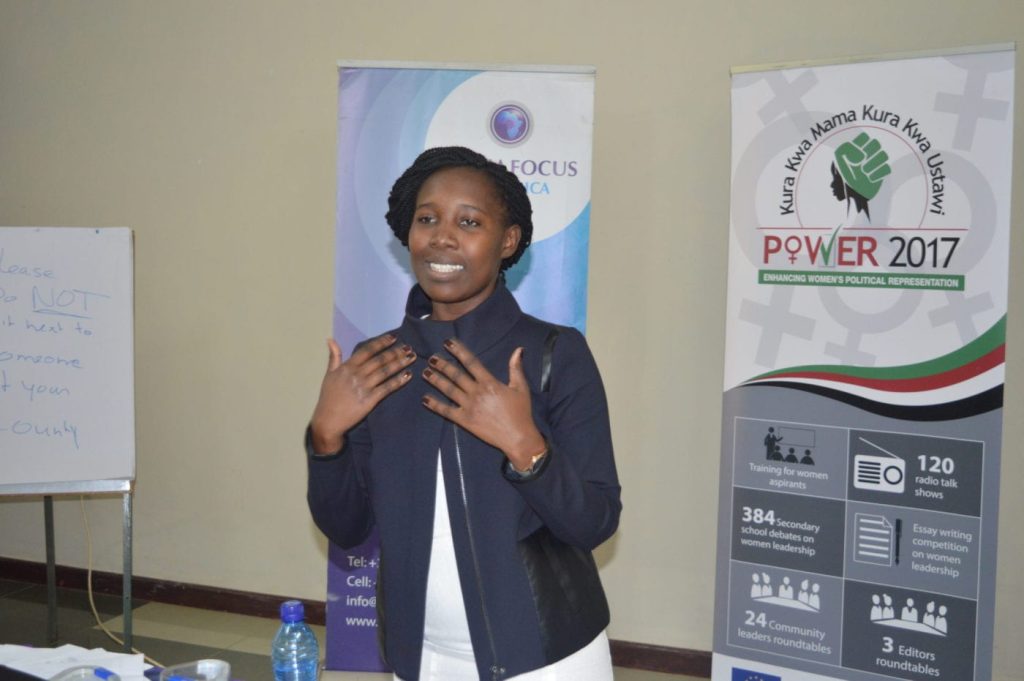
[bctt tweet=”Reaping profits from the media space while vouching for public-interest journalism is Frenny Jowi’s hustle” via=”no”] Frenny Jowi is a journalist, a digital media and PR consultant. She also creates media coverage strategies with a bias on social media campaigns. Currently Frenny is the lead consultant at Media Focus on Africa, as a media relations trainer, digital journalism trainer, and radio producer. For 4 years Frenny had a successful career at one of the world’s leading international broadcasters, the BBC. While working for BBC Africa both in Kenya and the United Kingdom, she led several productions including creating digital content for younger audiences and news coverage of historic president Obama visit to Africa. Showing off her inner #MotherlandMogul, Frenny is also the Founder Image Masters PR & Communications, where she works in partnership with the UK-based Peter Burdin Africa Foundation and world roving Ilona Eveleens Media. To top that all off, Frenny also works as a volunteer youth mentor and freelance journalist. Tell us, how did you get to the BBC from a local Kenyan media house? I worked briefly at a little-known community radio station, Exodus Network, then moved into a giant newsroom, the Nation Media Group headquarters in Nairobi. It was my first real experience of working in a converged in newsroom. I enjoyed the complexity of things. KTN came to recruit from my school when I was in my third year. My adventurous self then jumped into TV journalism. All this while, the editors made me file international stories as a trainee reporter. The tone of the wire copies about Africa made me uncomfortable. I wondered, where was Africa’s genuine voice on the global debate and take on issues? I wanted the news through African eyes for the world. As a young African I was best placed to tell the story. The international broadcaster I had grown up listening to, was the first to spot my talent, so I joined as an intern after doing some voice test, translation and script writing interviews. I started off as an intern at the East Africa Bureau in Nairobi and quickly gained skills as a bilingual reporter and producer for BBC Swahili and many other BBC World Service Programmes/ My favourite was and still is the Fifth Floor Programme. I told the African story as I had dreamt. I was nominated for the 2014 Kenya Annual Journalism Excellence in Journalism Awards. [bctt tweet=”I told the African story as I had dreamt – Frenny Jowi ” username=”SheLeadsAfrica”] What prompted you to move back to Kenya? Moving to London to work for the BBC was one the most exciting moments in my career at the BBC. I loved London’s palace gardens! Kensington was my best, the Gothic architecture and the Thames during summer. After one year of doing so much including producing President Obama’s visit to Africa, my work visa practically sent me packing! That was not a bad thing, I was to wait for one year cool off period to renew my work visa, but then came flooding ideas of what I could do at home instead of a rigorous visa application process. At the time when I lived in London, there was a growing anti-migrant sentiment. My work visa had labeled me such, migrant staff. London treated me well, but I don’t want to shy away from saying the migrant stories made me very uncomfortable. I was working from the centre of the world when waves of Brexit became more pronounced. I was right at the centre of one of the world’s most influential broadcasters when news of drowning African migrants would dominate the news for weeks. Meeting my former schoolmates who had settled in London permanently, we often talked much about we could do for the continent, it wasn’t just talk for me. I am back home to do something for the continent. Why do you call yourself a media entrepreneur? When I started working in the newsroom, I realized the industry was evolving fast and profits were put first. I felt that this compromised storytelling as public interest was given second priority or none at all. I also saw the potential in digital migration and social media that opened up space for multiple media houses. This was supported with more democratic space in Kenya, that allowed countless radio and TV stations to operate freely. So, I sought to reap profits from the growing media space. At the same time, I wanted to rigorously vouch for a public-interest journalism model. Despite lacking experience in running a business, I registered my company and started off pitching for work as a communications consultant and content producer. I was confident the myriad new radio and TV stations needed quality content. It was just the right time to turn my journalism skills into a strong business idea. My company, Image Masters, had been a dormant Facebook page for four years. I breathed life into it, created a company profile and hit the ground running producing for the BBC’s Arts Daily Programme. I then moved on to consult for KTN, a leading TV station in Kenya that was then setting up Kenya’s first 24-hour news channel. Since then, I have worked with many other clients create alternative educative content for younger audiences. My biggest project now radio plays and shows themed on women leadership. I have a bias for social media which many organizations are now embracing as mainstream. One year on, I am now proudly self-employed and working with great partners to deliver for clients. I am leveraging on partnerships to compensate for the need of staff. The future can only be bright. What is the first thing any young woman who wants to start out as a media entrepreneur do? Let confidence and courage lead you. Never muffle your dreams thinking that you are not ready yet. Carefully reconsider your talents, skills, and networks. Figure out how much of your abilities are lying underutilized. Get to work. I know you may
Job hunting 101: 6 survival tips for the aspiring Motherland Mogul

[bctt tweet=”Are you feeling personally victimised by the job application process? These tips are for you” username=”SheLeadsAfrica”] Anybody here feel personally victimised by the job application process? Yeah, me too. I thought having a degree would mean people would come knocking at my door, begging me to work with them. Wishful thinking. I’ve come to realise the job is not going to find you, you’ve got to go to look for it. The process can be so tiring but it has to be done, you know, if you want food on the table or that life you’ve always dreamt of. First-time job seekers, this one is for you; welcome to job hunting 101. The devil is in the details Your C.V is the first thing your potential employers will see. They need to be able to pick out key highlights of your professional experience at a glance. It is also important to streamline your C.V, what about it says ‘I am perfect for this job‘. Remove irrelevant details. Nobody needs to know you got mad skills with the knitting needles unless you’re applying for a job in the weaving industry. If that’s the case, make sure your portfolio shows all you can do. Make sure your professional accomplishments are distinguishable, that’s how you get your brand out there. Your cover letter is just as important. Be prepared to write countless versions, each tailored for the company you are applying to. Research the company. Add small details, such as why you like the ethics of the company or how you would be a great fit. This lets them know that you aren’t sending a generic cover letter but that the interest is real. Apply, Apply, Apply!!! The application process can be slow and tedious. Set aside a day to focus on sending out applications. The truth is that not everyone will respond. Don’t give up! There is no harm in putting your C.V out there, it is more likely to do good than harm. Be proactive, drop your CV off at places you are interested in. Don’t worry about your pride, she can’t get you a job, determination though? She is your best friend. You’ve got to be prepared to do whatever it takes to get your foot in the door. Don’t underestimate the power of resources like LinkedIn. Create a detailed and notable profile that will make you stand out as a viable candidate. You can also use LinkedIn to reach out to professionals in your field to check if they have any openings or ask for advice. The resources are endless, use them to your best advantage. Apply for your dream job, apply for the practical jobs. The key thing here is to never stop applying. I repeat. Never stop applying. [bctt tweet=”There is no harm in putting your C.V out there, it is more likely to do good than harm” username=”SheLeadsAfrica”] Be patient Easier said than done, right? Companies are more likely to not respond to your application and somehow actually receiving a rejection email is more comforting than deafening silence. Don’t be discouraged, something’s gotta give. Something will give! The worst expectation you can have when you start applying is that job offers will flow in constantly. Getting your first job could take months but it will happen, it’s not impossible but it’s not easy either. Just keep swimming Getting a job after university or after a slump is hard. Especially when it feels as if everyone around you is getting great jobs, moving forward and leaving you behind. This is on top of the actual overwhelming feeling of job applications. People sit and tell you to get a job as if you can wake up, snap your fingers and have it. The external pressure is suffocating. Remember, don’t compare journeys, your path is just that, yours. Comparing yourself to your friends won’t get you a job, it will just make you miserable. Focus on what’s important and go get it. [bctt tweet=”Comparing yourself to your friends won’t get you a job, it will just make you miserable” username=”SheLeadsAfrica”] Go the extra mile At some point, the job hunt will make you feel like you are going crazy. You’ll find yourself applying to jobs that seem out of your field. And that is okay! Look at job opportunities that may require you to step out of the traditional thoughts of how your career should look. Each experience should inform and be a stepping stone for the next. Connection is key People like to make you feel that asking for help when looking for a job is shameful. Nobody got time for that. Put your pride back in your pocket, you don’t need her. Network and connect. Jobs are often about who know as much as you having the necessary skills for them. It is key to keep contact with people in your industry, even if it is with your peers or with someone you once interned for. Keep yourself on their mind, so when opportunities arise they think of you first. When someone sees a job that they may not be available for or isn’t in their field, they can refer you. Make and keep strong genuine connections. Connect with as many people as you can and stay in touch, help others out, the path to employment isn’t one you have to walk alone.
Ngasuma Kanyeka: Creating cutting edge communication solutions

[bctt tweet=”You have to have a 360-degree view of the world around you to create the type of solutions we do” via=”no”] Known for her tenacious spirit, humor, and sharp thinking, Ngasuma Kanyeka is a Dar e Salaam based entrepreneur, strategic thinker and feminist. Her company, Capacitate Consulting Ltd creates cutting edge communication solutions for institutions and governments. Ngasuma was involved in the creation of the national communication strategy for the oil and gas sector in Tanzania in order to manage expectations of various stakeholders. She has been an integral part of the African Union Youth Volunteer Corps since its inception. When asked which colour crayon she would be if she was added to a new crayon box her answer was RED because that describes her bold passion. Ngasuma shares her passions and entrepreneurial experiences which I hope will inspire you to harness your talents. What is Ngasuma best known for? I am known for my tenacious spirit, humor and sharp thinking. Also, I am an incurable sarcastic enthusiast who loves a good play on words (I have an artistic flare). I am known for being a dynamic, strategic thinker who loves a good challenge and for lighting fire under peoples’ backside to get moving. I visualize a lot of the world and I believe we are more connected than we realize. Oh and without wanting to change it, even if I could, I am an African, a feminist, a woman (these three are not in any particular order of priority) and fundamentally a human being. A little hippy, a little nerdy and a little cool. What is Capacitate Consulting Ltd and what prompted you to start it? As part of my Masters’ studies, I investigated women who prevail beyond their circumstances and manage to achieve wellbeing. This was based on a psychological theory known as Salutogenesis. I was fascinated and I learnt a great deal about women who managed to navigate their existence and lead balanced, thriving lives. I met a woman who really impressed me and made me question how I had ended up with 17 years of education and I had not recognized my own power and the endless opportunities availed to me in this world. That is what prompted me to start Capacitate. I met a woman who really impressed me and made me question how I had ended up with 17 years of education and I had not recognized my own power and the endless opportunities availed to me in this world. That is what prompted me to start Capacitate. From a young age, I started to volunteer my skills and expertise and enthusiasm. When I was just 16, I was running environmental campaigns with the Jane Goddall Institute. Also, I was engaged in my community from teaching kids in my neighborhood during my holiday break to running awareness campaigns to empower girls. I have always been a busy bee, refusing to see that there were challenges too great to be tackled. I have always wanted to contribute and become a doer. That is how I ended up working as a journalist, that curiosity sparks a need to voice these issues, but my analytical side wanted the numbers to back it up and so I studied for a degree in IT. Meanwhile, I was interested in human behavior which is how I ended up studying Health Promotion. It makes perfect sense to me, but it is an upheaval of confusion for people looking at my resume. I recently got a short story accepted for publication and two poems published by a UNESCO project called Badilisha. So Meanwhile, I was interested in human behavior which is how I ended up studying Health Promotion. It makes perfect sense to me, but it is an upheaval of confusion for people looking at my resume. I recently got a short story accepted for publication and two poems published by a UNESCO project called Badilisha. So Capacitate encompasses these passions, it is the coming together of skills and expertise that my colleagues and I have garnered through the years to create cutting edge communication solutions for institutions and governments. You have to have a 360-degreee view of the world around you to create the type of solutions we do. Tell me something about your last job, other than money, that has inspired you to keep doing what you do. I am actually selective about projects I take, I work through referrals. Ultimately, I want to look at myself in the mirror and be satisfied. So I have turned down several, supposedly lucrative projects that did not sit well with my value system. I did not come here to do evil. One of the recent projects I am happy about is when I led the creation of the national communication strategy for the oil and gas sector in Tanzania to manage expectations of various stakeholders. Communities, where the oil and gas extraction activities take place, believed that they would get rich overnight. This expectation management strategy will build their understanding of the sector and also create a sense of ownership for them to make deliberate steps to benefit from the sector as it develops. I wanted to be part of changing the narrative that natural resources are a curse, it lends too much to that narrative that Africa is a dark continent. We Africans are not cursed. We are intelligent beings that can manage, make decisions and make choices once we are informed of what our options are, like everyone else in the world we want the best for ourselves. I am also exceptionally proud of the African Union Youth Volunteer Corps program that I have been a part of since inception, there is no greater joy than to see the endless number of African youth that has grown and thrived from it. It is truly one of the greatest programs in the world, and it has fostered a greater understanding of who we are as a people and the
Peace Hyde’s 10 Tips to fighting against the odds – The guide
[bctt tweet=” “Shortcuts never last as long as hard work does” – @peace_hy ” username=”SheLeadsAfrica”] Success doesn’t appear overnight, you have to put in a good amount of hard work and also work hard to overcome any challenges that arise. You work for it by fighting against the odds. Award-winning TV host and Forbes West Africa correspondent – Peace Hyde, is on a mission to encourage young African women to be bold and break barriers, through her new show “Against the Odds”. During an Instagram Q & A with us on Tuesday, May 30, she shared some of her personal experiences and how she managed to overcome them. “My biggest obstacle so far was continuing to move forward after the tragic accident I endured on June the 3rd in Ghana”, she wrote during the chat. Some of Africa’s leading female entrepreneurs like Folorunsho Alakija, Bethlehem Tihalun Alemu, Isis Nyong’o Madison to name a few, are women who have fought against the odds in their respective industries. [bctt tweet=”Get @peace_hy ’s top 10 tips to fighting against all odds ” username=”SheLeadsAfrica”] If you’re going through a hard time now, or you would like to know what steps to take to achieve greatness, then you’ve got to get this guide. Getting access to this guide is easy, just fill out the form below to join our community and get access to this guide, as well our oh so amazing weekend newsletters.