
Tania Omotayo: Watching my father work so hard, I couldn’t imagine doing less

[bctt tweet=”Discover @TaniaOmotayo’s #MotherlandMogul and boss side in this interview” username=”SheLeadsAfrica”] Tania Omotayo is officially our WCW and general #MotherlandMogul goals. The half-Nigerian and half-Austrian beauty is a well-known personality in the Nigerian entertainment scene. Like many enterprising young women, Tania Omotayo does not put her hustle in one basket. On one hand, she is a Senior Creative Analyst at the Temple Management Company (TMC), a leading talent management and events company. On the other, Tania is a model and an entrepreneur. She never stops moving forward and we can thank her dad for that. If you’ve heard of Tania Omotayo and always wanted to know more, or if you’re curious to know the insights of working in the Nigerian entertainment industry, what are you waiting for? Read on! What would you like the world to know about Tania? I would like the world to know that I am a hard-working and focused young woman. I am a Senior Creative Analyst at the Temple Management Company (TMC) which is a leading talent management and events company. Also, I am a model and an entrepreneur. I don’t think I ever stop. If it doesn’t have something to do with my regular 9-5 job then it’s my personal business. I am always up to something. I learnt from my father, watching him work so hard my whole life, I couldn’t imagine doing less. And it is something I am extremely proud of. [bctt tweet=”Tania Omotayo: If it’s not my 9-5 job then it’s my personal business. I am always up to something” username=”SheLeadsAfrica”] What legacy do you see yourself leaving in this world? It’s weird because it’s not something I spend a great deal of time thinking about. But I do hope to leave my mark on this planet in some way. I hope to be remembered as one of the pioneers at the Temple Management Company, that brought change to the Nigerian entertainment industry. I hope to be remembered for doing amazing things for charity, impacting people’s lives and for genuinely making a difference. Tell us more about the Temple Management Company. How did it come about? The Temple Management Company was founded by Mr. Idris Olorunnimbe at the start of 2016. TMC is a child of necessity, the company was started to bring structure and change to our entertainment industry. We are a 360 full-service talent agency and talent management company. We specialize in the representation of personalities with African heritage from all over the globe in the entertainment, sports, media, public and arts sectors. Also, we specialize in the management of events in the entertainment, sports, media, public and arts sectors. I am proud to say that I am part of the nucleus group that helped build the company from the very beginning. [bctt tweet=”@TaniaOmotayo hopes to be a pioneer that brought change to the Nigerian entertainment industry” username=”SheLeadsAfrica”] How do you plan to scale up the Temple Management company in the next few years? We have so many big plans and projects we are working on. I think the main thing is we are focused on changing the game, and we do things differently and properly. We have a lot of extension plans which we have already started with South Africa, Kenya, United Kingdom and the United States. So, in a few years I am sure we will be leaving our footprint worldwide. What’s one thing about the industry you work in that you would like to change? If I had to change one thing, it would be to create a platform so that we have the same structure in place as the rest of the world. Nigeria is one of the few countries in which talents do not really get royalties or adequate compensation from our hard work. I think it is unfair and dispiriting. If I only had one thing to change, it would definitely be to improve the welfare of our talents when compared with the rest of the world. [bctt tweet=”If I only had one thing to change, it would definitely be to improve the welfare of our talents @TaniaOmotayo” username=”SheLeadsAfrica”] What’s a typical day like for you? I actually do not have a typical day. My weekdays are completely different from my weekends. I have crazy weekdays, and more chilled days. On my crazy days, it can be waking up at 5 am and finishing work at 10pm, on days like that I really can’t do anything else. But on my more chilled days, I start work at 9 am and finish between 5 and 7pm. On days like that, I have time to watch a favourite TV show or a movie. On the weekends I like to sleep as much as I can so I am fresh for the week. So I usually spend most of it in bed. What motto(s) do you live by? I have so many, but these are some of my favourites and I’ll explain why: “Someone else is happy with less than what you have” – This helps me to remember to appreciate what I have. “Success is the best revenge”- This is pretty self explanatory when people don’t believe in you or try and water down your dreams, the best way to get them back is to succeed at it. “Happiness is yours to choose or reject. So embrace it.” – This took me a while to fully understand but now I am a pro at choosing to be happy. You should never let other people ruin your happiness. What can we expect from you in 2017? For 2017 you can expect a lot from me. Outside of working for Temple, I am working on a really exciting fashion project that I cannot wait to reveal. It is something that I have been working on for over a year now and I am super excited. I am also working to solidify my brand as a model and I have some projects coming up that I
Sihle Hlophe: The film industry still largely sexist, and at times racist

[bctt tweet=”Sihle Hlope chooses the stories that she wants to tell through her communications business” username=”SheLeadsAfrica”] In a modern world of film, deeply ingrained and out-dated sexist misconceptions are still stamped on film scripts and video cameras. It wouldn’t be a truthful to say the women working behind the scenes of some great productions, worked with smiles on their faces from beginning to end. In South Africa, there are some really talented women directors who do not get enough recognition. Sihle Hlophe is a rising 30-year-old film director who is challenging the ingrained sexism of the industry through storytelling. Sihle has openly spoken about sexism in film. She is a holder of the current ICA fellowship and the chairperson of Writer’s Guild of South Africa. Journalist, Khethiwe Mndawe got to interview Sihle for SLA while she was in London for the Screenwriters’ Festival with the Writers’ Guild of South Africa. Briefly describe how running your own business in the film and production industry has been for you as a young black woman. I started my company, Passion Seeds Communications in order to promote minority languages and make a contribution towards the alleviation of youth unemployment. I also wanted to give a platform to marginalized female technicians such as cinematographers, editors and sound recordists. Although the journey has been rocky, it has also been very fulfilling. The biggest challenge is the difficulty in accessing funding for films. However, the government has progressive incentives in place to help young entrepreneurs. Another challenge is that the industry is still largely sexist, and at times racist. One has to be persistent; knocking on doors and getting rejected repeatedly is not for the faint-hearted. The best part about owning my own production company is creating jobs, training young people and of course, getting to choose the stories that I want to tell. Which film production projects have you done that closely targets stories related to Mpumalanga or the neighbouring borders, eg, Swaziland? Both of my short films are SiSwati films. You can see some of them on my Twitter page. I have not had the opportunity to shoot in Mpumalanga. This is due to lack of support from the province, even though both my films are ‘set’ in Mpumalanga. I shoot in Gauteng because that is where I get support. I must mention though that I was deeply touched when the Department of Arts & Culture recognized my work by presenting me with a ‘Best SiSwati Film’ award at the Mpumalanga Provincial Arts & Sports Awards in 2015; I just wish that support would extend to actual productions. Also, I did a short documentary a few years ago based in Swaziland. Its topic is related to the reed dance of virgin girls. [bctt tweet=”One has to be persistent in face of the challenges in the film production industry” username=”SheLeadsAfrica”] Which countries abroad have you visited and what were you representing there? My film ‘As I Am’ has been screened at prestigious film festivals in the USA, Switzerland, Tanzania and here in South Africa. With support from the Department of Trade & Industry, my company Passion Seed Communications has been to film festivals and markets in France, the Netherlands, the USA, England, Germany and Canada. I was also an exchange student in Helsinki, Finland during my final year as a film student at Wits University. Other countries I have visited include Brazil, Kenya, Lesotho, Poland, Estonia, Holland, Swaziland and Botswana. I would like to visit Asia next. What unique experiences did you come across in these countries? I have experienced many unique things in many different countries. One of my greatest experiences as a filmmaker is when I am afforded the opportunity to share my story with people from different walks of life. To see that story resonate with those people is the most powerful thing a storyteller can experience. [bctt tweet=”@NubianStorytela’s films have been screened at prestigious film festivals in different countries” username=”SheLeadsAfrica”] What changes would you like to see in the industry when it comes to opportunities for African women directors? There are some really talented women directors who do not get any work or recognition because of deeply ingrained and outdated sexist misconceptions. It’s truly sad. Some directors are also subjected to sexism and sexual harassment. I would like to see this change! Enough is enough. I would also like to see the government of Mpumalanga investing in its talent and supporting filmmakers like other provinces do. I have more chances of getting support from the Durban Film Commission than I do in my own home province. For me, that is a tragic situation. What have been you greatest achievements so far? Finishing my Masters degree under very trying circumstances and writing and directing two SiSwati films. I am an advocate of minority languages. In fact, the title of my Masters paper was, “The Underrepresentation of Minority Languages on SABC 1: The case of SiSwati“. I have been passionate about promoting my mother tongue for as long as I can remember. You were recently granted the ICA fellowship, congratulations! What is it about? I was one of the fellows chosen by The Institute for Creative Arts (ICA) for 2016. The opportunity is awarded to creative thinkers and doers in diverse disciplines. ICA fellowships encourages collaborative dialogue around issues of urbanism, community, historical legacy and the postcolonial imaginary. Fellows are encouraged to test boundaries, engage with new publics, and to explore the critical potentialities of live art. The ICA is particularly excited about the diverse contributions and imaginative ways of thinking presented by this year’s fellows –from performative writing, dance and music, to art, curatorship and interdisciplinary research. Conversations, exhibitions and public interventions presented by fellows will be announced in due course. Tell us briefly about “Nomfundo”? “Nomfundo” is a short film about a conflicted, young woman whose life is irrevocably changed when she has a transcendental encounter with someone from her past. The film is currently in post-production. It is my second
Sandra Myambu: Uplifting young people through social entrepreneurship
[bctt tweet=”Sandra Myambu is working towards giving school-leavers the skills that will make them employable” username=”SheLeadsAfrica”] Sandra Myambu is currently a Portfolio Programme Analyst at Dimension Data where she is involved in delivery and support of global, strategic projects. She is also the MD for Masana Social Innovations. During her university years, Sandra joined Enactus as Project Manager then Vice President. She also volunteered as a Skills Development Trainer and Project coordinator at an NGO. When Sandra began working for Dimension Data, she still wanted to continue having an impact to society. By seeing the number of graduates increase in parallel with youth unemployment, the idea for Masana Social Innovations was stimulated. Sandra found out from various research exercises that many graduates lacked skills that deemed them employable, especially in the ICT sector. This is when she started Masana Social Innovations to uplift young people. Sandra shares with SLA contributor, Anelisa Kasper her challenges and motivators of starting Masana Social Innovations with a full-time job. How has your journey/transition from corporate to entrepreneurship been like? As I’m currently still in corporate and have recently started with Masana, my transition into entrepreneurship hasn’t been hard. Masana’s aim is to use technology innovations to enable the civil society, corporates and state entities to deliver sustainable social solutions to communities. This will be achieved through bridging the skills gap in the ICT industry with a key focus on women, through the facilitation of various skills development programmes. This doesn’t mean it will be easy for everyone, as experiences vary from one person to the next. I haven’t had to transition as much. The most important thing was to find a balance between my corporate and my entrepreneurship venture. I have always been involved in entrepreneurial activities so juggling my job and my new business is familiar territory. There have been serious adjustments, where Masana and my job are demanding at the same time. What has helped me keep the balance was to be able to effectively manage my time. As I am the MD of Masana, it’s easier to manage my work and assign work to myself that also ensures that my job does not take major strain. [bctt tweet=”Sandra Myambu found out that many graduates lacked skills that made them employable” username=”SheLeadsAfrica”] What have been your hardest moments, and how have you overcome them and still overcoming them? I have big dreams and aspirations for Masana as a social enterprise, and not just as an NGO. Articulating my vision for the organisation has been one of the biggest challenges to date. What I’ve learned from trying to explain that vision is putting it into smaller goals, e.g. this is where Masana is going this year in order for it to get where Masana ultimately needs to be. Articulating the vision to people will still be a problem in the future because Masana is trying to use innovation to drive real social change. The issue is that people are still not ready to invest in social innovation or community programmes. The hope is that reaching out to more people in smaller scales and trying to explain the vision will help in increasing the buy-in. One of the major challenges that Masana is still experiencing is getting the right buy-in from the right people. It takes time to establish those relationships and to most importantly, maintain them. Common ground and common interest are key in getting buy-in from investors for your business. [bctt tweet=”Sandra Myambu: I’ve always had entrepreneurial activities so balancing is familiar” username=”SheLeadsAfrica”] What keeps you going in making sure you make Masana Social Innovations an even bigger success? It’s about knowing how whether small or big the initiatives Masana has, they are valued and they have a real impact on young people and the community. Recently, Masana hosted Africa Code Week in October. During the code week, Masana trained over 600 young people on basic coding skills. In addition, 60% – 70% of the participants were women. The programme had a big impact, and has opened up more women to coding, even if it’s starting at basic coding skills. The initiatives that Masana holds have had a big impact. Not just to impart people with coding skills which are essential, but also to make people realise that technology is also essential. The success of a business can also be determined by the technology you choose to run your business with. Uplifting young people is a motivator for continuing with my entrepreneurship venture. My target market has been young people from under-serviced communities and previously disadvantaged areas. Uplifting young women who do not believe they can get the same opportunities that our male counterparts receive. Most importantly, to uplift these young women in believing that they can do well in the world of tech. [bctt tweet=”According to @_WisaniSandra people aren’t ready to invest in social innovation” username=”SheLeadsAfrica”] Who have been your biggest supporters through your journey? How have they been supportive? My biggest support system is my family, my friends and a few of my colleagues. I have also received support from mentors in my professional and academic life, and conferences. Those mentors have played various roles in different stages of my life. My mom and sister have been the most supportive where I’m able to bounce off ideas with them. What has also helped has also been surrounding myself with friends that are also entrepreneurial and who have similar interests. Attending the #SheHiveJoburg event this November, in that short period of time, meeting amazing, young black woman who are also visionaries and have aspirations of their own. Those ladies have become key individuals in my networks. [bctt tweet=”Masana is uplifting young women who don’t believe they can get the same opportunities men receive” username=”SheLeadsAfrica”] What are your plans to ensure that Masana reaches a bigger audience and brings value to more people? Masana is still at it’s very beginning stages. So far, we’ve successfully implemented the Africa Code Week initiative. A SAP
Kagure Wamunyu: I always see opposition as an opportunity to grow
[bctt tweet=”Kagure Wamunyu: I think figuring out what it is you want to do in life, early in life, is key” username=”SheLeadsAfrica”] It’s always great to see our African sisters take on non-traditional fields such as technology and engineering. One such woman who has literally made technology her niche is Kagure Wamunyu. The 27 year old is the current head of logistics and operations at Uber Kenya. Kagure is changing the way women lead in the tech industry by following her own path and refusing to take no for an answer. She has carved her way into the industry meticulously with not one, not two, but three degrees under her belt. Kagure quickly returned to her beloved home-town, Nairobi to use her knowledge and expertise in improving the transport and urban planning industries, two things she is very passionate about. Diana Odero, our SLA contributor had a great chat with Kagure to find out what it is that keeps her motivated to do what she does and why she believes in always paying it forward. Word on the street is that you were Uber Kenya’s first full-time employee. How did you bag that role coming straight out of uni? I was recruited to join the organization during my last year as a postgraduate student through LinkedIn. I think what they really liked was the fact that I had picked a particular course and specialized in it throughout my academic career and work experience. All my research projects were transportation planning based and I mostly focused on Nairobi so I knew the topic and the area very well. Reading up on Nairobi gave me great knowledge on the industry there, which I used during my interviews with them and that resulted into me getting the job. Your road to Uber has been quite fascinating. An internship at the UN just before joining the company, a Masters degree from UC Berkeley and you also completed two degrees concurrently in college —all funded by scholarships might we add… How did you manage to study abroad for over five years and what would you advice young girls striving for the same to do? I was fortunate enough to go and study in the US with the help of Zawadi Africa Education Fund, a program that provides scholarships to bright young girls who show leadership potential. I discovered Zawadi Africa while in high school and I think my taking initiative to actually want to be part of the program got me the scholarship I needed to go for further studies. Then, I was awarded a scholarship by Meredith College where I studied Mathematics and Civil Engineering. I think figuring out what it is you want to do in life, early in life, is key in helping you achieve your goals. I knew what I wanted to be and I saw that this school in particular would allow me a chance to do a dual degree so I took the opportunity. Being in school for five years as opposed to the traditional four meant a lot of balancing and multi-tasking on my part but every minute was worth it. As for my Masters, I applied the same method, I looked for schools that had the course I wanted, looked up scholarship opportunities within those schools and applied. I was never scared or apprehensive about either application, I just saw an opportunity and went for it. There have been instances when there was public opposition from your taxi drivers about changes within the company such as drastic price cuts. How did you handle this public conflict? For me, it’s very important to believe in what I do. It’s very important to believe in the impact the work that I do has in my community, in my city and in my country. It helps that my background is in urban planning so I have a holistic view in terms of what is going on. When you believe in what you do, most of the time you have to set the misconceptions straight. When people are talking negatively about the work that you are doing or the impact the company has, more often than not, it’s always about misinformation or miscommunication. [bctt tweet=”Kagure Wamunyu: Tell things from your perspective and believe it as you say it.” username=”SheLeadsAfrica”] I handled this public conflict through telling my story, as it is very important to set the record straight, first and foremost. Tell things from your perspective and believe it as you say it. I always see opposition as an opportunity to grow, it gives me a reason to dig deeper into my work and see what the problem is and explain to them exactly what I meant by my decision. What tips do you have for those interested in joining the technology/urban planning field? For those interested in this field, and this is especially to the women; we always feel like technology is all about coding and programming which by the way, I can do neither. There are so many other things you can do in the world of technology and it’s just a matter of taking the leap. Be good at what you do now, be good at what you have chosen. Be it communications, urban planning, legal studies or engineering. Should you decide you want to be part of the technology sector, know that these companies need all these different functions to work. So if you have perfected your niche, whatever field it may be in, you will be able to find opportunities in the tech world. At the same time, find out what it is the tech companies look for, research on which direction the field is moving towards and improve and groom yourself for that role. [bctt tweet=”Kagure Wamunyu: If you have perfected your niche, you will be able to find opportunities” username=”SheLeadsAfrica”] What has been the proudest moment of your career? In May earlier this year, we announced a partnership with Sidian Bank for USD$100
3 steps to end the year on a high

[bctt tweet=”For the remainder of 2016, @CoachAsanda urges you as a business owner to give it all you have” username=”SheLeadsAfrica”] For most of us, the next couple of weeks are crucial for business. Things may not have gone the way we planned these past couple of months. Typically, you’re dealing with unpaid invoices, which are resulting in cash flow challenges. You are relentlessly trying to ensure you meet your sales targets. All of this can be rather stressful at a time when you should be already planning for the next year. Remember though that there is a lot that is out of your hands. My advice is to rather focus your energies on what you have the power to achieve. For the remainder of 2016, I urge you as a business owner to give it all you have. Yes, the year may not have gone the way you would have liked it to, but you can still end on high spirits. You can adjust your attitude and end on a high note! Here are three tips I’ve used myself, which I credit for my excitement when the year comes to a close. 1. Recall your past successes When things are not going our way, we tend to focus on what is not right and neglect to appreciate what has gone right. Yes, you may have had serious financial challenges, yet you managed to keep your business going. How did you do that? You were determined to make it happen —appreciate yourself for that drive and don’t pass up the opportunity to congratulate yourself. What is the one thing you didn’t think you could pull off that you did? Think of all the wins you experienced since the beginning of the year. When you realise that you DO have a track record of success, you are positioning yourself more favourably to go for more wins. [bctt tweet=”As we draw to the end of 2016, think of all the wins you experienced this year” username=”SheLeadsAfrica”] 2. Set yourself bit-sized goals Most people set long term-ish goals; be it yearly or quarterly and these are not as fluid as I believe they ought to be. Things change, priorities change and unless you have your goals’ sheet fluid, you tend to not spend enough time on realigning, changing and even removing those goals that no longer serve you. The result? When it’s time to see how you’ve done, you have items you did not achieve. The point of setting goals is to achieve them, so what’s the point of not achieving what you’ve set out to? So for the next month, draw up realistic, interrogated bi-weekly goals. The name of the game is to accumulate those small wins as they pave the way for bigger ones. [bctt tweet=”For the next month, draw up realistic, interrogated bi-weekly goals” username=”SheLeadsAfrica”] 3. Adopt feedforward planning The past is behind you! What has gone wrong has done just that; gone wrong. Spend the next month on getting feedforward and not feedback. So instead of asking your clients how you did, rather ask them how you can best service them going forward. A typical question you could ask is, “For the next month how can our service be to your liking?” If you have staff you could get their feedforward on how you can best be a better boss to them. When you focus on the future, you feel empowered because you have the power to influence what happens in the future. Getting feedback on the other hand is too focused on what has already happened. [bctt tweet=”You can move from dreading year-end to appreciating all that you have gone through” username=”SheLeadsAfrica”] You may not have the power to change your balance sheet over the next couple of weeks but you do have the power to change your attitude. You can move from dreading year-end, to appreciating all that you have gone through and preparing yourself for the next year. The choice is yours. End 2016 on a high where your business is concerned and 2017 will not know what hit it!
Habiba Wushishi: Food should not just be eaten but be enjoyed

[bctt tweet=”It has always been my dream to be innovative with my cooking – Habiba Wushishi” username=”SheLeadsAfrica”] You know a real foodie when she talks about food evoking emotions and cooking being a married of ingredients. We’re talking about Habiba Wushihi here, founder and spice-mixologist (yeah, we just made this up) behind Sydney’s Cuisine. Habiba just loves food and she wants everyone to enjoy the tastiness and variety of Nigerian cuisine. That’s such a dope goal. Through Sydney’s Cuisine, she’s creating a new culture around how we appreciate Nigerian food which she hopes to expand globally through franchising. Read on to discover how Habiba will achieve her goals. She’s got lots of great advice for baby start-ups too. Why are you passionate about delivering good food in Nigeria? As a foodie, I understand that there are people who eat just to fill up, and people that actually love food. I believe that food should not just be eaten but be enjoyed. Nigeria is a country that boasts of so many traditional dishes from a myriad of cultures within it. Each culture has its own blend of flavours and ingredients which makes all of the food unique. Sydney’s Cuisine’s concept is based on an infusion of Nigerian and Intercontinental flavours. To that point, I too have started ‘The Sydney’s Culture’ which aims to continuously entertain my customers with bursts of flavours as they eat. The beauty of the Nigerian food culture is that we all eat and appreciate each other’s food from all parts of the country. One thing that is for certain is that Nigerians love to eat. This is befitting for me as it has always been my dream to be innovative with my cooking and create new and updated dishes that I know will attract a lot of people. When you are running any food business, the main priority is to be able to satisfy a variety of palettes and to enhance customers’ dining experience. Food has the ability to evoke positive emotions. Maybe you are having a stressful day at work, and my food has put a smile on your face. This is immensely rewarding for me knowing that I have provided a good service. Sydney’s Cuisine is dedicated to delivering good food in Nigeria not only to quench hunger and satisfy cravings, but also to create awareness about the next phase of Nigerian cooking. What makes Sydney’s Cuisine different from the other food and catering businesses that exist on the market? Before I started this business, I did research on as many food businesses as I could. More often than not, you come up with some idea(s) that someone or several others already have executed. I realised, after conducting my research, that my food concept and brand culture would take-off based on that special component, that makeover, that je ne sais quoi, that is much needed in the Nigerian food and catering market. Not long after, I had an epiphany —cooked food is a marriage of ingredients! In this case, my food concept would be to infuse Intercontinental flavours into the Nigerian cuisine. What sets Sydney’s Cuisine apart from the rest is that there are at least 15 different Nigerian and Intercontinental spices in all of our meals. This achieves a level of flavour that is so desirable, it has proved to be a tad overwhelming (in a good way) for a few of our customers. [bctt tweet=”Sydney’s Cuisine blends at least 15 different Nigerian and foreign spices in all meals” username=”SheLeadsAfrica”] One of my goals is for Sydney’s Cuisine to appeal to people around the world, and the best way to achieve that is to provide a sense of familiarity by cooking with ingredients known to people from a specific country. I want the rest of the world to have a taste of the Nigerian cuisine and in turn, I’d like Nigerians to experience other flavours in food. Just like people all over world eat and enjoy the Asian cuisine. Global corporations like Google, Amazon, and Microsoft have their own individual business culture. This culture has played a huge role in the success of these companies. You don’t really hear about food/catering businesses and their cultures. Culture is a substantial part of any business and should be incorporated into every business. I am gradually developing the Sydney’s Cuisine culture that will make it stand out. Since this is your first start-up, what are the hardest parts of getting your venture off the ground and how are you looking to fill in the gaps? With any start-up, you will be faced with tough challenges. Teething problems are to be expected at the start of any food business. At first, when any issue arose, I found myself panicking and even doubting myself and my capabilities. I started this business on my own and without any partners. As a result, I had to juggle several roles and responsibilities to ensure quality control and efficiency. I was a manager, accountant, marketer (via social media platforms), food orders supervisor, packager, just to name a few. Sometimes, I would focus on one or two roles and because of this I would have missed a few orders or endanger the quality of the meals. Each role is just as significant as the other which is why I became very anxious in the beginning. [bctt tweet=”I found myself panicking and even doubting myself and my capabilities – Habiba Wushishi” username=”SheLeadsAfrica”] When you are starting a new business, you may not want to hire a manager from the onset because you want to save on costs. So I decided to try out a couple of routines and figure out the best one for me to follow. Since then, I have come up with a system that works perfectly and has enabled me to settle into all those roles comfortably. And as the business grows, I will create a team to fill the roles. Day to day operations will always be a challenge and
4 things to learn from the lady mechanic, Oduwa Agboneni
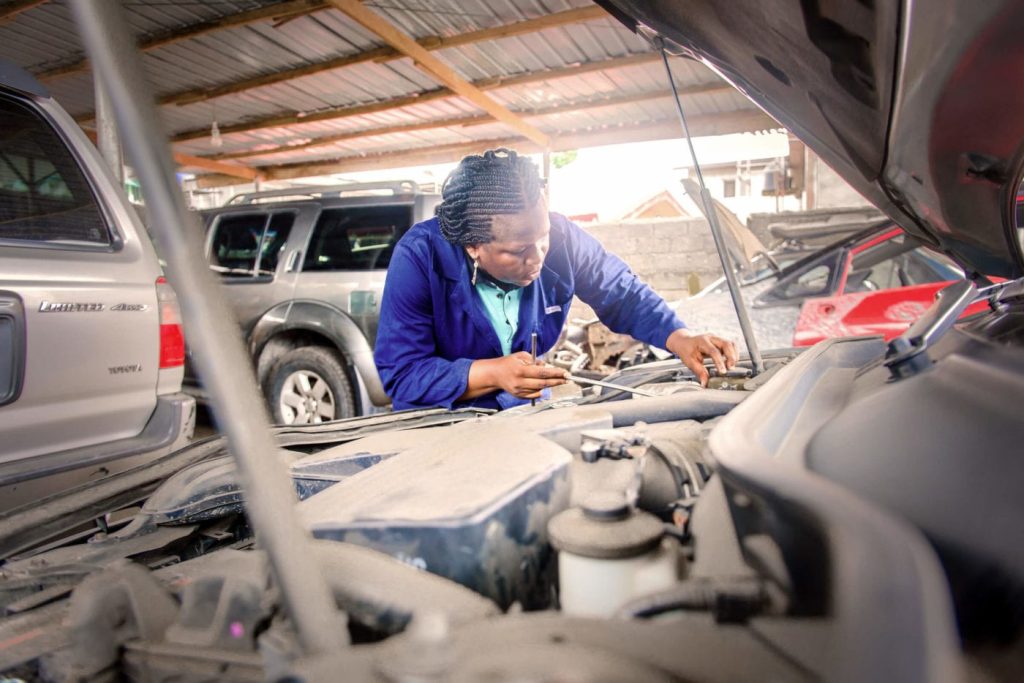
[bctt tweet=”There is nothing like male-dominated field – Oduwa Agboneni, the lady mechanic” username=”SheLeadsAfrica”] Oduwa Agboneni is an entrepreneur in a seemingly male-dominated field. By the way, she doesn’t believe that crap of “male dominated” anything. Oh yes, we love that kick-ass spirit. She had her first degree in Mechanical Engineering from the University of Benin before proceeding to the University of Lagos for a Masters degree in Geoinformatics. She worked previously in the mechanical industry but since she’s always had a flair for business, she knew it was a matter of time before launching hers. Oduwa is the founder of Neni’s Auto Care. Her services range from car wash and detailing (odour removal, polishing, washing, fumigating) to auto-repair (auto diagnosis, body work, panel beating, electrical) and home based repairs. Presently, her employees are 80% male. Although her male staff are fine with her leadership, most times they tell her that she is the first woman they have worked with. They love Oduwa’s leadership skills so much that they no longer see her as a woman. To Oduwa, this shows that success has no gender neither does leadership in the “male-dominated” field. Her goal is to be the richest black woman in Africa. Oduwa would also love to see her business represented in all states in Nigeria and all countries in Africa. She plans to set up an NGO to empower young ladies in STEM, all while being the best wife and mother. Here are four things SLA contributor Ugochi learned after a chat with Oduwa: 1. The most difficult part of being an entrepreneur isn’t funding but coming up with a sustainable idea Motherland Moguls, you need to get in here. Contrary to perception that funding is the major challenge for business owners, Oduwa believes this is not the case. A good idea will always bring in the money eventually. So dream big, start small and grow steadily. She started from a car wash to developing a garage and now Neni’s Auto Care has evolved to perform other services. Good ideas would eventually attract funds as Oduwa is a 2015 recipient of the Tony Elumelu Entrepreneurship Programme (TEEP) grant. [bctt tweet=”A good idea will always bring in the money eventually – Oduwa Agboneni” username=”SheLeadsAfrica”] 2. There is nothing like “male-dominated” field Oduwa believes that this is a thing of the mind in this part of the world. So, know what you want and go for it. Motherland Moguls, what are you waiting for? 3. It’s a fallacy that you can’t be feminine in a “male dominated” field Now, there’s that phrase again “male-dominated” but this line of thought is absolutely bullocks. According to Oduwa, it’s all about time management. You can still look good, make your hair and be girly irrespective of the industry you operate in. 4. You can ace marriage and career Even though she has always been a career person, Oduwa knew she had to blend it with her marriage. She has learned to create a balance between her work and her home. Ugochi and Oduwa are currently undergoing a training programme together and Oduwa brought her baby along. But you’d never know there is a baby there because Oduwa is so coordinated and still contributes meaningfully in class. Talk about doing well in all areas. [bctt tweet=”#MotherlandMoguls need to dream big and be open to partnerships” username=”SheLeadsAfrica”] Final words to the Motherland Mogul You need to dream big and be open to partnerships. Pay attention to your customers and your employees because you need them to grow your business. Be focused, hard-working, determined and prepared at all times. Live your dreams. Want to see women you know featured on SLA? Tell us what amazing things women are doing in your communities here.
A battle of the mind: Leadership lessons from Sheryl Sandberg

[bctt tweet=”Our self-perception as women is actually what keeps you from moving ahead” username=”SheLeadsAfrica”] I was fourteen, maybe fifteen and straight out of primary school, it was my first day in high school. My incoming class teacher asked me if I was willing to be the class prefect. I flat out said no. I just was not willing to take up a leadership position to a group of people whom I had never met before. This was despite the fact that I knew I was more than capable of doing the job and doing it well. Fast forward three years later I ended up taking a leadership position not only in my class, but in the entire school. Looking back though, I see the same trend repeating itself in my life over and over and that is what Sheryl Sandberg’s book Lean In: Women, Work and the Will to Lead is about. We do it to ourselves Initially, I thought the book was going to be about your basic feminist tirade. I was pleasantly surprised though, when from the get-go she focused more on how the self-perception that women have is actually what keeps them from moving ahead. ‘Sit at the table’ made it to my top three favourite chapters of the book. Sandberg discusses how women face a “battle from within” that prevents them from taking advantage of what rightly belongs to them. In the chapter, Sandberg gives a story about a certain meeting she hosted for government representatives —both men and women. After picking their cups of coffee, the men sat around the conference table but the women opted to sit off to the side of the room, even after much prodding from her. It was an innate decision they made to keep themselves away from issues under discussion even though they had every right to be there. [bctt tweet=”Women hesitate to take advantage of what rightly belongs to them” username=”SheLeadsAfrica”] It’s possible to have it all In the 8th chapter, Sandberg brings up a common argument as far as women empowerment is concerned when she talks about making you partner, a real partner. She talks about the traditional gender roles in homes and how to overcome the limitations that these roles throw at women as far as career planning is concerned. The discussion revolves around empowerment taking place at home as much as it is being demanded in the work place. By having men take on more responsibility around the home, traditional gender roles are discouraged. Rather, this encourages an equal playing field in the workplace and at home. An idea that if put into practice in our homes, will enable us to excel both in our careers and in our families. In Africa, especially due to our cultural inclinations this here is easier said than done. Yet, if we are going to let Africa see what we are capable of we must get the entire community involved in this mind shift. The boys’ club mentality Generally, Sandberg’s book gives quite a good insight on the limitations placed on women both internally and externally. This was my key take-away. What I hear mostly around the office corridors is the existence of a certain secret ‘’boys club’’ that seeks to promote only the men in the career journey. [bctt tweet=”Woman empowerment is only attainable when both men and women pursue them together” username=”SheLeadsAfrica”] What I don’t hear is talk on the limitations that we as women have placed on ourselves. It’s very easy to complain about how the system has been designed to work against our growth. While we are in that mind-set we forget to look at the limitations that we are placing on ourselves. Sandberg seems to have begun a kind of movement from the book, a not–so-secret girls’ club that should hopefully get all of us out of the pity party we might have in and work hard to get what we are looking to get. Lean In is definitely worth the read. It is witty, it’s well researched and very open, giving you a glimpse into the lives of top women leaders in the Silicon Valley. You see their weakness and failures and how they rise up in the leadership space. If you haven’t already read it, I suggest getting a copy. Not just for yourself but for your partner as well because as Sandberg discusses in the final chapter of the book. The goals of women empowerment are only attainable when both men and women pursue them together, at home and in the office and it begins by thinking that it is possible and worth the pursuit. Today, despite all of the gains we have made, neither men nor women have real choice. Until women have supportive employers and colleagues as well as partners who share family responsibilities, they don’t have real choice. And until men are fully respected for contributing inside the home, they don’t have real choice either. Equal opportunity is not equal unless everyone receives the encouragement that makes seizing those opportunities possible. Only then can both men and women achieve their full potential –Lean In
Working to learn versus working to earn: The Millennial dilemma

[bctt tweet=”Does it mean more for you to work to learn right now or work to earn?” username=”SheLeadsAfrica”] Admittedly most of us enter the job market with high hopes and plans to make waves working 9-5 and ultimately, leaving a footprint. In the excitement of the dawning of a new day; we sometimes forget that there are tough decisions that we need to ponder. This realization usually means an inevitable transition that takes us on a joy ride. Happy New Year! First of all, congratulations! You get to do all of the things which you set out to achieve as soon as you graduated and you are fired up with zeal to the brim. As a result you’ve been granted the opportunity-of-a-lifetime. The universe and your grancestors have been on your side; all that’s left to do is, SLAy! Yet, there’s a disclaimer, this job you’ve been offered does not pay enough for you to rent, pay off tertiary debt and have a social life. But, you’re probably fresh from university and in need of expertise. You’re thinking surely it won’t be long until you climb the corporate ladder, right? [bctt tweet=”Being a Motherland Mogul, you know that you cannot play with your earning potential” username=”SheLeadsAfrica”] Earning Potential Almost all your previous stresses and worries come through like; “Oh? You thought you’d be 20-something, driving your dream car and living in your luxurious penthouse?” Ha! You thought you were so woke and resolved and then got a feel of the juice. Being a Motherland Mogul, you know that you cannot play with your earning potential; that experience begets zeros, and recognition in your chosen field or vocation. So you need to draw up a list of priorities and take it from there. Question: Does it mean more for you to work to learn right now or work to earn? The ramifications of either decision Consequently, adulting comes with the unavoidable task of choices. So opting to work to earn could mean you forsake active mentorship —your job may not necessarily be in the trade or industry you may have wanted to be in. Or you may be working with individuals who are not invested in impacting any significant change within the industry because all they are about is the bottom line. The plus side to this is the fact that you will be able to settle your student debt, send money back home and be able to start saving to purchase property or buy a car. The reverse scenario is accepting a job to learn, truly dedicating oneself to the course of learning as many tricks of the trade and attending networking sessions to establish a strong foothold in the industry. Huge disclaimer: the remuneration may not live up to the job title and expectation of duties to be carried out. The silver lining on this cloud would be that what you gain in experience can always be made up for in monetary value at a later stage. [bctt tweet=”It is possible to have your cake and eat it when it comes to work situations” username=”SheLeadsAfrica”] The grass may not always be greener Whether one is working to earn, or working to learn —there are both pros and cons to each scenario. The situation will vary from person to person and it is your prerogative to choose whichever works for you at a particular juncture in life. As such; you need to decide from a place of clarity and being grounded in what you wants for yourself. It is possible to have your cake and eat it; inasmuch as something may look attractive to you, it may not be all that it is cut out to be. [bctt tweet=”The world of vocation is a journey of continual learning writes @ZimK_Mvandaba” username=”SheLeadsAfrica”] Striking a balance The world of vocation is a journey of continual learning. By asking yourself deliberate questions about the aspirations you have and what fulfillment you want from a career, you will be a step closer. There is a preparedness that goes into the decision process guiding you from university to the world of work. Asking for help is not something to shy away from. Also, you could spend the first few years post-grad school interning or in a learnership to gain practical experience and take charge of the learning opportunities on offer. Alternatively, one could start off working to earn and building on their professional and academic portfolio simultaneously. There is no right or wrong, just make decisions that work for you as an individual.
10 things to accomplish in your career in your twenties
[bctt tweet=”The top 10 career lessons you should master in your twenties to be the #boss ” username=”SheLeadsAfrica”] It’s never too late (or too early) to accomplish anything in your career. I do not believe that there’s a calendar that everyone should follow as they go about in life. Advancing in your career in your twenties is not easy at all. Life gets more complex as we get older and having some guidelines is what every girl needs. To keep the momentum going in your career, there are things you can do to propel you even further. Read on for the top 10 career lessons you should master in this decade of your life. 1. Establish career goals In order to get to where you want to go, you have to first figure out where you want to go. Do not be one of those people who think that the career they want will be handed to them without clear planning and execution. In your twenties, think long and hard about what you want to achieve. Once you’ve thought things through, put in deliberate effort to achieve them. It is rare that things will go exactly as planned, so you have to adjust your plans accordingly. Imagine your job as an engineer turned out to be such a headache that you cannot bear to do it an extra day. You will then have to regularly revisit and adjust your career plan accordingly. 2. Build meaningful relationships Any smart woman knows it’s very important to develop good professional relationships. This should not just be internally in your organisation but also with external stakeholders (think customers, suppliers). You have probably heard the phrase that your network is your net worth. All opportunities are attached to people. They won’t come to you in a vacuum. Investing in meaningful relationships during your twenties is key. [bctt tweet=”Don’t allow your professional growth to stall in your 20s! Use these tips and learn” username=”SheLeadsAfrica”] 3. Experiment with a side hustle Everyone should experiment with a side hustle outside their careers, yes even you. Taking up a side hustle has many pros. It has the potential to not only enrich your life, but also expand your horizons. A side hustle can be a good way to try out a new career with minimal risks. Also, with a side hustle you can develop skills you wouldn’t have developed at your day job. This can ultimately get you to where you want to be, with a more meaningful job. Don’t allow your professional growth to stall in your twenties! Take up a side hustle can accelerate your learning. 4. Give back to your community You can always do more than that by giving back to your local community. There are many opportunities to add value, no matter your financial situation. Don’t think that it is only those who are balling that who can give back. Find out what is it that you care about and look for ways to get involved. Volunteer for your local church, participate in your company’s corporate social responsibility projects, start your own non-profit or give to a charitable foundation. Whatever cause is close to your heart, get involved in making this world a better place. It needs you. 5. Invest in yourself Don’t wait for an employer to invest in you. What will happen if they don’t believe in you and your colleagues keep getting the opportunities? Take charge of your personal development by setting aside money in your budget just for this purpose. Buy books, take courses and utilize free resources. Find career sites to follow in your industry. Do not be too broke to invest in yourself. [bctt tweet=”You’re in charge of your own success but let’s be real, you’ll need some help to get that career you want ” username=”SheLeadsAfrica”] 6. Get a mentor/sponsor/coach You are in charge of your own success. But let’s be real, the most successful professionals are those who realise that they need help and ask for it. Identify some people you admire and reach out to them. A sponsor in your industry of choice can determine whether you grow in your company or don’t. If you can’t get a mentor or sponsor, buy the services of a coach and make good use of them. You will most likey get some tough love, and it might be just you need to succeed. Getting come accountability in your life is one of the first steps to success. 7. Build your personal brand Whether you want to believe it or not, you are building a personal brand with every interaction you have. So, why not take charge of developing it into something you admire? Make a conscious decision on how you want to be perceived by others and make an effort to get there. It will take time to grow your personal brand but once you get started, you will not want to stop. 8. Build an enviable work ethic When we are young, we dream about all the things we’ll be. As we grow older though, we realize that nothing comes to the dreamer. Instead, the people who achieve great things are those who work on their dreams every time they get. Your twenties are the time to bust your ass working to prove yourself in your industry. If you want something you’ve never had, you must be willing to do something you have never had. [bctt tweet=”Your twenties are the time to bust your ass working, these 10 tips ensure it’s not all in vain” username=”SheLeadsAfrica”] 9. Be comfortable in your own skin I remember when I was just starting my career, I was shy and very introverted, always scared to raise my voice. As I got older, I got comfortable with my personality and what I had to offer to the world. Too many times, we are afraid to speak out because of inner criticism. Do not be so hard on yourself. Put on some bravery, learn your weaknesses but accentuate your strengths.