
Monique Ntumngia: Unpack your fears and take bold steps to conquer them
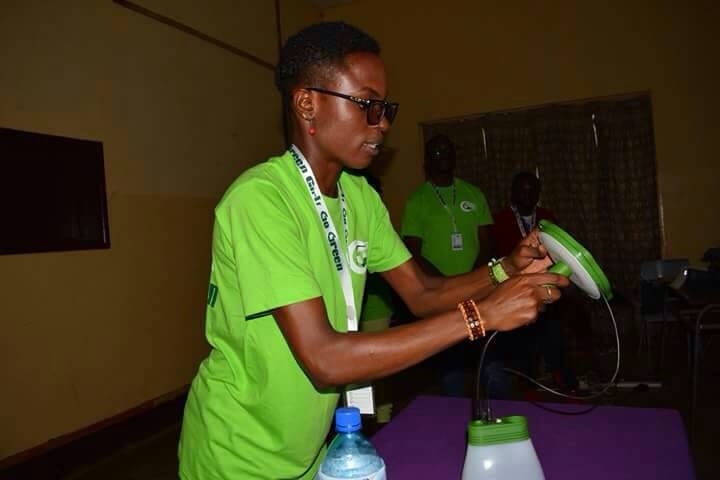
Monique Ntumngia is a human rights advocate against violations on women and girls. She is very passionate about entrepreneurship and promoting sustainable development in Africa with the use of renewable energy. Currently she is the President of the Green Girls NGO and CEO & Founder of Monafrik Energy. Her impressive track record includes: 3000 households supplied with biogas, 672 young girls trained, 23 communities helped and tremendous media exposure in Africa, Europe, America and Asia. Monique Ntumngia has been the Director of Sales and Marketing of Heta Energy in Cameroon and Program Officer in charge of Gender and Human Rights for the Resource Centre for Human Rights and Civic Education. She started her career as company Executive Legal Assistant for Human-As Cameroun. Monique fluently speaks English and French and is a holder of an LLB Law from the University of Buea in Cameroon. [bctt tweet=”Cameroon’s Green Girls Project has trained 672 girls, provided over 3000 households with biogas and installed solar panels in over 100 homes” username=”SheLeadsAfrica”] Can you tell us more about the Cameroon’s Green Girls Project? The Green Girls organization’s activity is to render girls financially independent through inclusive educational tech training on renewable energy, in a bid to eliminate poverty and fight climate change. Since activities commenced in October 2016, 672 girls from 23 rural communities have been trained- from 3 out of the 10 regions of Cameroon. Over 3000 households have been provided with biogas and over 100 homes installed with solar panels. How do you select the girls to train and what’s the duration of training? Communities are chosen based on a sample resulting from a native never- seen- before SDG scoring model. Eligible communities are pre- selected with the participation of donors or grants. In that community, the number of girls to undergo training is shortlisted, representing the demography of the locality. The flexible constraint for Green Girls is to target girls aged 14 – 18 years. Training runs from a week plus, depending on the number of girls and the community. How are you able to support this project? The project is mainly supported by grants from donor organizations, the cross fertilized team made up of: Cameroonians, Senegalese and French and strong partnerships. What obstacles would you say that you’ve had to overcome to get where you are today? Obstacles encountered have been numerous ranging from economic, social, cultural, technological, regulatory and demographic. Economically, the cost of training is very high and funds from donor organizations are not always easy to come by There is also the high cost of equipment and transportation to the communities. Social obstacles include the orientation of mindsets to adopt clean green practices and language barrier. The resistance to using renewable energy to cook because of fears that food cooked with biogas wouldn’t taste properly was a bit of a cultural obstacle. Technologically, the training requires accurate expertise in the domain of renewable energy which is not easy to have because not many are trained in the field of renewable energy. Regulatory authorizations have not been easy to acquire permitting the training to be carried out in communities. Demographic obstacles include the massive trend of rural exodus in the communities. What are some of the traits every lady should adopt in order to succeed? The traits every lady should adopt to succeed are: a) Unpack your fears and take bold steps to conquer them b) Find a mentor c) Be passionate about what you do and be focused d) Stand your ground and show your strength e) Always think positive and keep an optimistic spirit Do you have any other passion projects you would like to develop? Green Girls focuses on the actual project in order to trigger organic growth. Share with us a fun memory from your teenage years. Having to interact and empower young Muslim girls in Kano on the advantages of education. Are you in the renewable energy field? Share your story with She Leads Africa, let us know more about you and your story here.
Salma Abdulai: Failure is part of succeeding
[bctt tweet=”Others will believe in you, if you believe in yourself” username=”SheLeadsAfrica”] Mrs. Salma Abdulai is the Chief Executive Officer of Unique Quality Product Enterprise. With a background in Agriculture Science from her senior high school level, she continued her education at the University for Development Studies where she studied Agriculture Technology and majored in Agricultural Economics and Extension. In addition to that, she has a postgraduate degree in MPhil Agricultural Economics from the same University. Salma Abdulai has 9 years of experience working on different projects with international non-profit organizations. She has extensive experience in the agriculture sector, particularly working with small scale rural farmers and women groups. The company is a reflection of her experience and passion for agriculture and social consciousness. Mrs. Abdulai is currently responsible for the overall management of the company and its day-to-day operations. “High influx of imported food products in the country is making local goods less competitive” You started your company in 2013; can you tell us what the first 6 months was like? The first 6 months were vague, even though the results to achieve were clear, the process was not very clear to me. It was all about planning on how to take off, where to get the necessary materials, how many women farmers should we support, what other equipment do we require? It felt like there were a lot of things to be done by one person. What support system and tools have helped you in the course of running your enterprise? We constituted an advisory board, which had diverse experiences in various fields to advise us on key decisions the enterprise took. This actually reduced the risk we faced against some of the actions we made. It also helped the business stay focused and concentrated on very important things in the midst of the limited resources. Attending networking events has brought the enterprise a lot of referrals in terms of market and financing. We weren’t able to attend all, but we made it a point to attend as many as possible. Social Media has become the most popular marketing and information tool; we use social media for marketing and sharing a lot of information on our product. I also got a lot of support from family in terms of resources and advice. What are some of the challenges facing the agricultural sector? High influx of imported food products in the country is making local goods less competitive. Inadequate funding because of the risk associated with this sector, adding the adverse effect of the impact of climate change in this sector is making it more difficult to get funding. Lack of implementation of government policies on agriculture. What do you think the government can do to improve the agricultural sector in Ghana? Make good policies to favour small business in the agribusiness sector, by developing and promoting policies that directly affect the growth of the sector. This can include cutting down on importation of food products, increase capacity of farmers to produce more and support businesses to absorb increased food surplus by adding value. Enhance institutions that directly deal with farmers with the necessary resources to do so. Create a favorable environment for small businesses to thrive. Also the government should strive to reduce bureaucracy in our public institutions. [bctt tweet=”Failure is part of succeeding” username=”SheLeadsAfrica”] Share with us the most valuable lesson you’ve learnt about yourself and others from your journey in life thus far? I have learnt to believe in myself. When I believe that I can do something, I end up doing it, even if I face a lot of challenges. Others believe in you if you believe in yourself. Failure is part of succeeding. It is not always the decision you have made that you will always succeed at, but believe me, if you fail, you become stronger and wiser. [bctt tweet=”I have learnt to believe in myself” username=”SheLeadsAfrica”] What three skills have helped you overtime in business? Time management, Routine planning of daily activities, patience. What’s the most courageous thing you have done? The most courageous thing I have done is reviving a cereal that went extinct in my area and getting women to produce it even when they did not have access to land. If you were to host few friends for lunch, what meal would you make with Fonio? I will prepare Fonio chicken salad for lunch and Fonio pudding for dessert. Are you in the agricultural business? How has your experience been thus far? If you’d like to share your story with She Leads Africa, let us know more about you and your story here.
Afia Bobia Amanfo: Entrepreneurship as a vehicle for social change
Afia Bobia Amanfo is the co-founder of Studentshubgh, a non-profit organisation committed to the mentoring and grooming of young people in sub-Saharan Africa. Even though she comes from an administrative background, Afia finds fulfillment addressing the challenges of disadvantaged young people and connecting them with opportunities. She has been involved with volunteer outreaches to villages and schools in Ghana for several years, before starting Studentshubgh with her co-founder, Nana Ofosu Boakye. Afia is a graduate of the University of Ghana, Legon and the University of Lille in France. She is currently registered for the Master’s degree in International Trade at the Universite de Paris Est Creteil, France. Her career goals are to become a social entrepreneur as well as an international business analyst. Afia has a strong relationship with God, which she sees as the foundation for everything she does. [bctt tweet=”Young people are really starved for content that addresses their issues, directs and guides them and this is the gap we seek to fill – Afia Bobia Amanfo” username=”SheLeadsAfrica”] What made you take the leap into entrepreneurship? I have always had entrepreneurial dreams and a desire to use entrepreneurship as a vehicle for social change. But, for many years I held myself back because of a fear of failing. I finally decided to take the leap not because I had gathered enough courage, but because I was frustrated by the lack of access to quality content for young students in sub-Saharan Africa. I interact with a lot of young people and I was distressed. By the fact that many of them were making poor decisions concerning their career, academics, relationships and life in general because they didn’t have easy access to information or a qualified mentor. A quick check on most youth focused sites will show a bias towards entertainment. Definitely, the youth are interested in entertaining news and it is good business to give your customers what they want. However, young people on our continent are really starved for content that addresses their issues, and gives them direction and guidance. This is the gap we seek to fill. In addition, I was motivated by the desire to lend my voice to instilling a sense of patriotism and pride in African youth. I believe there will be a change in the future of Africa only to the extent that the youth are intentionally taught to believe in themselves as Africans; and learn to exploit their abilities to their fullest potential so they can become successful future leaders. So yes, I took the leap after lots of prayers and I have not regretted it. You built your website from scratch and you had no background experience to support this. From your experience what are the key resources and things to consider when creating a website? Thanks to the internet, no skill is too difficult to learn today. From graphic design to website or app development, the tools are all there on Youtube or a blog out there. So I will say: Start with research. You can research based on the type of website you want to build e.g. a magazine, blog, e-commerce etc. Determine the best domain name registration sites Find a hosting site Find templates and learn about plugins. You can find something whatever your budget is! Here are a few resources you need: Reliable internet connection. This is a must since you will spend several hours on your site. Domain name registration & hosting. You need to check for the availability of your domain name and register it as well. Most hosting services offer free domain name registration and free email address as part of the package. You can do a little research on the types of domain names and decide whether to register as a .com, .org, .gh etc. I have been using ehost.com as my hosting service which is quite affordable and also offer great customer service. Other hosting services include bluehost, godaddy etc. A website creation tool/ publishing platform. If you are a beginner like me, I will definitely recommend WordPress. WordPress has several templates ( both free and paid) and plugins. You can play around with various templates to find out what you want. I think if you have an online business, it is good to try your hand at designing your site, because experimenting with various templates will give you ideas and your site will end up better. You can always get an expert to add the touch-up’s, but do some experimenting on your own. Besides WordPress, you can also check other tools such as drupal, joomla or wix. You are going to need some great pictures for your site. There is definitely a lack of quality African stock photos online but there are a few options both free and paid. Check out pixabay.com, shutterstock.com and stockfreeimages.com Ok, so let’s just say that was manageable. Let’s talk about building a social media following of over 7000 and developing an e-magazine in just 6 months! What’s the secret Afia? I will say, there is actually no secret. The key to building a social media following has been widely discussed on many blogs and Youtube videos. I have watched She Leads Africa videos which spell out the strategy I used. A clear strategy: We decided to invest in creating a community on social media first before launching our website. Our strategy is 2 fold: Focused content and target advertising. To be honest, we have experimented a lot with content. We know our target audience and what we want to give them. Experimentation and iteration: However, we continue to experiment with the presentation of the content in order to achieve maximum impact. We have learned to consider that our target audience (students between 15 to 25) usually have very little to spend on data so we don’t do a lot of videos, we try shorter posts and also images with quotes, in order to get the message across. A well
Fatima Babakura: Social Media Made Our First Collection Successful
Fatima Babakura is a 21-year-old final year student at McMaster University and the founder and creative director of Timabee, a luxury accessory brand which she created out of her passion for sketching designs. Within 3 years of starting the business, Timabee has won a best fashion brand of the year award. Fatima has also been listed among 22 women redefining luxury in Africa by the Lionesses of Africa group, and has also received the WEF “Iconic Woman” award in 2017. Her passion for women and girls has inspired her to continue to grow Timabee, as well as start other businesses that would create job opportunities, especially in Africa. She is also the co- founder of Signature Boutique in Canada, a multi-brand boutique that aims to showcase the works of African based designers to the world. Fatima enjoys cooking, traveling and sharing her success story. [bctt tweet=”I have always loved accessories and handbags” username=”SheLeadsAfrica”] What inspired the Timabee brand? I have always loved accessories and handbags. Growing up, I remember being called “mummy’s handbag”, not because I followed her everywhere as that title would suggest, but because I was always holding my mother’s handbag when we went out together. I guess it was only natural that after I sketched a handbag, I became very curious to see it come to life. That is how Timabee started. What other services do you offer? Timabee currently has a bespoke section that allows the client to be a part of the design team for their handbag. You get to pick your leather, style and a whole lot more. I think it’s really cool. Do your services include any form of offline transactions or are they strictly online? Kindly tell us how the sales chain works. Being a full-time student and juggling a business doesn’t allow much time for offline interactions but I find ways to work around it.We have events from time to time and I also offer one on one bespoke sessions, depending on my availability. I am responsible for the bespoke side of design, amongst other things, so my schedule definitely affects those sessions. [bctt tweet=”With everyone being on social media these days, it is the best way to connect to a wider audience” username=”SheLeadsAfrica”] What are the major social media channels you make use of? Instagram and Twitter. Instagram is our first love. It made our very first collection a success. What has been the most challenging moment on social media so far? So far we haven’t had any challenge’s with social media, thankfully. What would your response be to someone who is contemplating whether or not to use social media as a marketing tool? I think it is a very great tool and it is inexpensive too. With everyone being on social media these days, it is the best way to connect to a wider audience. I would definitely say do it! Are you in the fashion accessories industry? Share your story with us, let us know more about you and your story here.
Just Omomo Ibe: Rule as a Boss, Rock like a Mum, Slay as a Wife

Business strategist and work- life balance expert, Just Omomo Ibe, is helping women create a balance between their work and personal life, so they can chase their dreams and make money while at it. She also helps individuals identify the various opportunities in their business to make more profit. Just Omomo Ibe has been in the banking sector for over seven years and is the founder of The Just Ibe Network; thus living her dreams while been an employee. She is involved in speaking engagements, coaching calls, online courses and business consulting for SME’s. Recently, she launched a Youtube show which focuses on motivation and strategies from experts in various fields, the channel is aimed at further helping her target market achieve success in their life and business. [bctt tweet=”It’s an act of self sabotage to neglect your dreams because you have a job” username=”SheLeadsAfrica”] Tell us about The Just Ibe Network The Just Ibe Network is a group of company that comprises our consulting firm, training and mentorship platform, it also includes an online training academy and media arm. At The Just Ibe Network we pride ourselves in delivering superior quality trainings, coaching and consulting for our esteemed clients both offline and online. What market research did you carry out in the course of starting your business, and how did you go about it? The first research was that of my competitors, I needed to find out what my competitors were offering and what gap they are not filling. This helped me make informed decisions as to how best to penetrate the market. A lot of businesses offer homogeneous products, therefore market research helps you understand how best to position your business in a way that not only meets the needs of your consumers but also positions your business as authentic. [bctt tweet=”Innovation keeps you in the business long after your competitors have gone” username=”SheLeadsAfrica”] What challenges have you faced so far in the setup of your business? The greatest challenge I faced in setting up my business was creating time to actually execute my plans; creating and fine tuning strategies that would keep me relevant in the market place today and always. Innovation keeps you in business long after your competitors have gone, so you must constantly innovate. What are your launch plans once your business registration is completed? Honestly a business registration isn’t stopping any major launch of my business, as all facets of my businesses are in full gear at the moment. The registration would just allow me operate a corporate account in the designated banks. So my take is it doesn’t matter if your business name is ready or not, keep adding value to your ideal clients and grow your business regardless. [bctt tweet=”It doesn’t matter if your business name is ready or not; keep adding value to your ideal clients and growing your business” username=”SheLeadsAfrica”] What inspired the book ‘Rule as a Boss, Rock like a Mum and Slay as a Wife? Rule as a Boss, Rock as a Mum, Slay as a Wife is a book dedicated to helping women create a work life- balance. Last year I started my career in public speaking, leveraging on several online platforms and offline avenues, despite been a full time banker, wife and mum. So people started asking me how I was doing all I was doing, so conveniently. I started documenting steps I have taken that helped me overcome my otherwise very tight schedule and results I achieved. This book is aimed at providing practical steps that can help women fully integrate all aspects of their lives, thus living a balanced and fulfilled life. What kind of investors and partnerships are necessary for your kind of business and what strategies are useful in achieving this? Media investors are required for the talk show arm of my business, which is targeted at providing strategies that would help entrepreneurs succeed and grow in business. Corporate investors also play a major role, especially companies who have CSR projects, ours can successfully pass as a CSR project aimed at helping young and budding entrepreneurs. Who is the one person from anywhere on the globe, you would love to interview and why? The one person I would love to interview is President Barack Obama. He is the one person I look up to the most, because he is probably about the best public speaker that exists in this day and age. [bctt tweet=”If you can think it you can definitely birth it” username=”SheLeadsAfrica”] What quote resonates with your business and how does it inspire you? We at The Just Ibe Network live by this mantra: if you can think it you can definitely birth it. So dear corporate ladies, your dreams are valid, they are your dreams for a reason, it’s an act of self sabotage to neglect your dreams because you have a job; the world needs you to live to the fullest. Have you mastered the art of work-life balance? Share your story, let us know more about you and your story here.
Hyjiah Mariam Conde: Low self-esteem is not given enough attention

I’m inspired by a girl who goes by the name, Hyjiah Mariam Conde, as young as she is, she has learnt the art of self love. She was bullied in school for her ethnic background, skin color & unique body image, but instead she decided to do empower herself. Hyjiah started her own nonprofit organization called SuperGirlzland. The purpose was for Hyjiah to be the voice to all the girls who have been emotionally and mentally bruised by being bullied. I had the opportunity to interview Hyjiah and this is what she had to share. [bctt tweet=”I want to shout so that the whole world may hear my vision and voice.” username=”SheLeadsAfrica”] Hyjiah you are an inspiration, you have been bold enough to stand up and be the voice of the youth. Is there anything you are afraid of? Thank you so much for your kind words. I would have to say the only thing that I’m afraid of would be GOD, as I feel that’s the only one I need to fear. Is there a reason you chose South Africa in particular, to kick start your charity? I actually kick started my charity in the USA where I’m from and expanded to South Africa and now West Africa, Guinea. I chose South Africa because I have a few connections there who are a part of my charity. Most importantly, I noticed that girls there were not allowing their confidence to shine through. So Hyjiah you are all about making other girls happy and special. What makes you happy? What makes me happy is being of service to others through my charity work. Seeing others filled with joy makes me happy. I saw an interview of you and you were talking about how you have become popular. How has that popularity changed you as a person? I don’t really see myself as popular. As a leader I believe that popularity isn’t important. Leadership and being compassionate are very important. I never changed. I’m the same person from 4 years ago when I started my vision. Can you share with us how far you are with the other interests you want to pursue like choreography, singing and maybe writing. I’m still working on recording my single which I wrote with my big brother. My dancing I do that mainly on the weekends. I love to dance it helps me to express myself. As for my writing I love to write. My book is set to launch soon and I’m already working on book number two. Do you have a plan in place of how you are going to achieve all your goals? My plan is to take it step- by- step. I keep notes on what’s next for me. So much of what I want to do is stored in my brain, so I have to keep notes of it all and GOD will help me achieve it all. I am just stunned! Honestly, with all these activities going on you are also an Ambassador and a member of a couple of groups. How do you manage your time? I prioritize really well, so I never burn myself out. I love staying busy, I’m very energetic and love to participate in so many things. I do take time for myself because I am still a kid. My mother, who is my manager, helps me prioritize things. Can you give a brief pitch to potential sponsors telling them why they should assist Supergirlz Land. Low self-esteem is not given enough attention. It’s a disease like any other sickness, which needs direct attention & support. Low self-esteem can be caused by bullying, poverty and lack of education; which at times result in suicide. Help me help them as we help one another to save our young girls, one at a time. Fun question! Would you rather be able to whisper or only able to shout? Pick one. I want to shout so that the whole world may hear my vision and voice! Have you overcome a low self esteem? Share with us how you did it. If you’d like to share your story with She Leads Africa, let us know more about you and your story here.
Nancy Gacheri: I have always had a passion for coming up with a business that would leave a mark in the Kenyan industry
Nancy Gacheri is the 25 year old director of Best Shoes Kenya (BSK), and a Bachelor of Business Information Technology graduate. Currently she is working as a Sales and Marketing Manager for Sunstar Hotel in Nairobi, Kenya. Nancy is passionate about entrepreneurship and strives to leave a legacy of positive change in everything she does. She currently blogs for Life after campus (http://whatelseaftercampus.co.ke/news/) and finds satisfaction in helping others. [bctt tweet=”The customer is the most important person in my business” username=”SheLeadsAfrica”] Who is Nancy? I am a God fearing, industrious, outgoing and well rounded young lady. I’m passionate about entrepreneurship and motivated by the need to bring the change I want to see in the world. What is Best Shoes Kenya? Best Shoes Kenya was established in May 2016. It is a footwear manufacturing startup company which uses locally sourced materials. We manufacture men casual and official leather shoes, as well as school wear. Our mission is to attain sustainable growth in business through the production of quality, affordable and classy shoes. We are a wholesale and retail shoe company situated at Membley estate Ruiru. How did you find a gap in the market for your business? The shoe industry in Kenya has seen most of its products coming from foreign countries. This pushed me to channel my entrepreneurship skills into shoe production. The need to produce quality and lasting Kenyan shoes is the motivation behind BSK. What are three key business lessons you have learnt since running BSK? I had to learn to separate business cash flow from my personal savings, by having a separate bank account. This means also setting it up legal through registration. The customer is the most important person in my business, they can either grow it or bring it down. Plan first, then act. A business plan is a key stepping stone to a successful venture, without one you just are planning to fail. How has the market responded to Best Shoes Kenya? At first it was really difficult because the local market perception is that Kenyan products cannot be of good quality. But with time, we have been able to gain a loyal client base. Most of which are repeat customers or referral customers. How do you balance your full time Sales and Marketing job and running the BSK business? This has been my greatest challenge up to date. My full time job is from 8 am to 5 pm and from work I head home where my workshop is, to see the day’s production. It has taken so much personal discipline and sacrifice, and it has cost me a social life. I dedicate most weekends to Best Shoes Kenya and to responding to various customer queries and follow ups. I am looking forward to running the business full-time, after raising a significant amount of cash to purchase the necessary machinery for production enhancement. What are two challenges you have faced and overcome at BSK? Market penetration was the greatest challenge due to poor product perception. The myth that locally made products are not good quality. But through the production of high quality products, which meet customer satisfaction, we were able to establish a loyal client base. Balancing between my full time job and running a business used to drain my energy significantly. But with time I have been able to strike a balance. What keeps you inspired to run your business each day? I am my own motivator, and I desire to become a change agent. The dream is to see BSK on the next level, as I explore my entrepreneurial spirit and positively impact lives. What is your three year growth plan for BSK? The three year plan for BSK is to be a front-runner of locally manufactured shoes in Kenya and the greater African market . To grow to have a ternary for leather, soles and all needed for the production of shoes. To begin a HUB which will promote the entrepreneurial spirit among Kenyans, and hopefully inspire the youth to realize their goals. In one sentence, how would you want to be remembered? I want to be remembered as someone who pursued her dreams and did not just get comfortable with living, until she brought about the change she wanted to see. Instagram: @gitsherry Facebook: bestshoeskenya Twitter: NancySheri Are you in the shoe manufacturing industry? Let us know more about you and your story here.
Mmabatho Mokgadi: I want to see Colorsofthearth among the list of top tea brands across Africa
Mmabatho Mokgadi from Soweto, Johannesburg, South Africa, Is the founder of Colorsofthearth. An organic loose leaf tea company specializing in herbal and fruit blends. Currently she is also a full- time student at the University of South Africa, completing her second year towards a Bachelor of Arts degree in Human Science and Social Services. Mmabatho loves yoga and is passionate about tea, particularly the medicinal components of herbal plants. When she is not reading on community psychology and the functioning of public services in South Africa, she is running her business from home. [bctt tweet=”I have a good support system from friends and family who encourage me” username=”SheLeadsAfrica”] Who is Mmabatho? I am the founder and tea tailor of Colorsofthearth. Currently I’m studying full-time at the University of South Africa, doing my second year towards a Bachelor of Arts degree in Human Science and Social Services. I’m passionate about tea, particularly the medicinal components of herbal plants. My current read is on Prof Maurice M. Iwu’s “handbook of African medicinal plants”. I enjoy yoga, great food and I’m always up for an adventure. What is Colorsofthearth? Colorsofthearth is an organic loose leaf tea company, with teas sourced locally and internationally. I specialise in handcrafted fruit tea blends (using spices, herbs and dried fruits) and herbal tea. How did you find a gap in the market for your business? When I established Colorsofthearth in 2015, all I knew was that I loved tea. As a result I had lost weight drinking yerba mate, white tea and green tea and my skin was looking healthier. I wanted to share this insight with people. I have extensive knowledge of the product because I used to work for one of South Africa’s leading tea franchises, The Tea Merchant. During this time I grew to learn that tea repairs and builds from the inside out. Even after I left The Tea Merchant the love for the tradition of tea continued. Soon I began making my own blends, playing around with herbs and dried fruits. When friends came over I would serve them the tea I made and they liked it a lot. A close friend of mine encouraged me to start my own business, saying that I’m “the tea person” because there’s nothing I didn’t know about tea. The tea industry is growing rapidly and I want to see Colorsofthearth among the list of top tea brands across Africa. How has the market responded to Colorsofthearth? In February 2017 I took Colorsofthearth to the South African Broadcasting Company canteen and the response was positive, there was a lot of interest and support. I have also exhibited at Market Esque in Soweto, but this crowd was different because most people were not interested in tea. I’m aware that people still have a certain stereotype about tea, which is: it is boring and should be consumed only if you are sick. But, I can say though that the response has been more positive than it has been negative and there is ample room for improvement and growth. What are three key business lessons you have learnt since running Colorsofthearth? Persistence How to manage finances The importance of market research. How do you balance your studies and running Colorsofthearth? I write out weekly and daily schedules which help me distribute time evenly. Although at times I give more attention to school work when I have assignments due or i’m preparing for exams. In addition to that, I use resources on SLA’s website regarding balancing studies and running a business. Overall I have a good support system from friends and family who encourage me and keep up to date with my progress. What are two challenges you have faced and overcome as Colorsofthearth? In 2016 I lost all hope and drive to keep Colorsofthearth running after my contract ended as a sales assistant at a kids clothing store. This happened a few months after I established Colorsofthearth. I could not afford the apartment I was staying in and had to move back home. The move did not make it easy. I was back home, no call backs for interviews and a failing business. It was challenging financially to keep Colorsofthearth running. But, In January of 2017 I decided to step out of my “hopelessness” mode and took it upon myself to finish the things I had started. Firstly, complete my undergraduate; I registered with UNISA and applied for funding, which was approved. I remember the excitement that came with the prospect of finally getting my degree! Secondly, I needed to pick my business up again. I had to go back to the drawing board and determine why I registered my business in the first place. I soon realised it was because of my passion for tea and the desire to create and provide a product that is healthy, sourced locally and refreshing. Communities like She Leads Africa helped me gain my self confidence and purpose again. [bctt tweet=”Feel the fear and do it anyway”, a mantra I live by daily. It’s also the title of Susan Jeffers’ book” username=”SheLeadsAfrica”] What keeps you inspired to run your business each day? My mother, my vision board and prayer. What is your three year growth plan for Colorsofthearth? My plan in the next three years is to supply hotels, restaurants and delis around Johannesburg and across South Africa. Either employ one person or find a partner that I can work with in running the business. Have an iced tea range. Build an online store with worldwide shipping. Travel and form relationships with tea plantation farmers in Africa: Kericho Kenya, Satemwa Malawi and Tanzania. In one sentence, how will you like to be remembered? A holistic wellness brand. Instagram: @colorsofthearth Facebook: colorsofthearth Twitter: @colorsofthearth Are you in the tea business or aspire to be? Let us know more about you and your story here.
Assil Diab: Being an Arab Muslim female painting the streets is not always applauded
Assil Diab, is a Sudanese visual artist, graphic designer and graffiti artist based in Doha, Qatar. She is the first female graffiti artist emerging from Qatar and Sudan. Assil graduated from Virginia Commonwealth University in 2011 with a Bachelor of Fine Arts Degree in Graphics Design. She also holds a diploma in Digital Marketing and a Diploma in Advanced Social Media Marketing & ORM. Known as ‘Sudalove’, today her work consists of mixed media and painting canvases using nothing but spray paint, “Graffiti on Canvas”. Assil’s first solo graffiti project was with SDI Marketing in Qatar where she was commissioned to paint at the Renaissance Hotel in Qatar for Cirque Eloize’s Press Conference. One of her great achievements was when she joined internationally known French-Tunisian artist El Seed in a Calligraffiti Project to paint one of the largest graffiti projects in the world in the Salwa Road Tunnels. Feature photograph by: Ahmed Shaheen  [bctt tweet=”I’m a very quite person in general but once I start talking, it’s through that can” username=”SheLeadsAfrica”] Photograph by: Tariq Mohammed Al-Fatieh When you are tagging you are basically speaking to the world through street art. From the responses you have had so far do people actually get the message? Being an Arab, Muslim female painting the streets is not always applauded. I’m a very quite person in general but once I start talking, it’s through that can.Graffiti is visually appealing because it is public art. It’s literally putting your art, thoughts, and feelings in people’s faces. Public art has the power to evoke thought and start dialogues. It is my way of communicating with society. Tell us about the very first time you decided to hit the walls. What was the first tag and how was it received? I started doing making art on paper and painting on t-shirts and shoes in my early teens. Then about three years ago, at the age of 25, I began taking it up as a profession. I used to see graffiti everywhere while riding the metro in New York- where I was doing my internship as a photographer & graphic designer in Brooklyn. I was fascinated by graffiti, with all its shapes and colors. I loved what I was seeing on the streets and I wanted to be a part of it. I’ve always liked challenging myself to see what I could do. So in 2013 I joined Public Works Authority ‘Ashghal’ and Qatar Museums Authority. I joined on a 4-month long internship to assist Tunisian-French calligraphist, El Seed, in painting the Salwa Road Tunnels; and that’s where I picked up a spray can for the first time. I have never put the spray can down since those intense 4 months of graffiti. My first exhibition was in VCU-Q Bookstore where I sold 9 paintings of 13 in just two days. The paintings were painted using nothing but spray paint aka “Graffiti on Canvas”. I later switched my signature from my original name assil.diab to SudaLove. Which is my way of expressing my love and represents my home country, Sudan. Photograph by: Ahmed Shaheen  There can be negative connotations associated with graffiti. What do you wish people knew? Graffiti is not just for men. It’s not all about hip-hop, or gang-related, and it doesn’t have to be illegal. Most people don’t take it seriously and fail to see it as a profession. In fact, most of my work is commissioned, so I do get paid for it. Also, often, people confuse mural art for graffiti or vice versa. There is a difference. There are no governing laws or rules to graffiti. Graffiti Is faster/quicker. But, there’s a lot of thought process & sketching when it comes to mural art, also, you don’t tend to use only spray paint when painting a mural. Do you ever collaborate? I’m working on a collaboration right now actually. I’m working with three local artists painting Aspire in Doha, Qatar. The first time I worked with these guys was in December 2016 painting in Katara. Besides these two collaborations I have only done exhibition collabs- where we all showcased our work on canvas in a particular hotel or gallery. Photograph by: Tariq Mohammed Al-Fatieh Approximately how much time do you devote to art? From the time I wake to whenever I need to go back to sleep. If I am not painting, I’m thinking about a sketch way before it needs to go up on a wall or canvas. My surroundings are full of art. I spend even more time looking at art, visiting museums, galleries, events, sketching and writing emails at least two hours a day talking about art. Or responding to emails that involve or commission artwork. [bctt tweet=”Even on the days when I don’t feel creative, I still have a consistent work ethic” username=”SheLeadsAfrica”] Are you still working on fashion as well? Yes, I get special, sometimes unusual requests for T-shirt designs. As a fashion designer, I do not specialize in one category of apparel- I hand paint T-shirts, shoes and hats. I’m also working on a collection of Sudanese women’s “teyabs” using contemporary designs for the younger generation. In 2010, I worked as an intern fashion photographer at Katya Moorman’s Style Defined NYC in Brooklyn, New York. I was also assisting with the design of the marketing materials for Better Than Kate, an award winning street style blog. In addition to taking various courses in fashion design, my graphic design degree provides the required skills for fashion. Photograph by: Tariq Mohammed Al-Fatieh What is your creative process is like? I practice a lot of sketching in my little black book. Sometimes I’ll scan a sketch and enhance it on illustrator or a similar program. Sketching helps me grow and develop. I get inspired by everything – religion, politics, travel, culture, earth, feelings and reading. When I’m interested in developing a new technique in graffiti, specifically, I go out and find a wall to practice on until it’s mastered. Even on the
Winifred Onyemaechi: I would like to be remembered as the lady who changed the face of farming in Africa
Winifred Onyemaechi is a farmer and the CEO Nature’s Kitchen Limited. She has a background in Business Administration and Management from the Institute of Management and Technology, Enugu. Winifred has also earned a certificate in Entrepreneurship Management from the Enterprise Development center of Pan Atlantic University, Lagos. With 8 years working experience in customer service and operations in the banking sector. Winifred recalls that when she was in banking, she barely had time for herself. This lack of time affected her food choices negatively. Often not having time to go source fresh meat to be slaughtered and cooked. This dilemma gave Winifred some insight into a gap in the market; fresh meat/ poultry which is easily accessible to families and people in the hospitality industry. This is how Nature’s Kitchen was born. She cites her major strength as her tenacity. “I don’t take no for an answer” in addition that she believes her other strengths include her ability to multitask and plan ahead. [bctt tweet=”when making decisions, I choose the option that scares me the most” username=”SheLeadsAfrica”] Who is Winifred Onyemaechi? Winifred Onyemaechi is a wife, farmer, agricultural entrepreneur and the CEO of Nature’s Kitchen Ltd. I worked in the banking industry for 8 years and then resigned to focus on Nature’s Kitchen. What is Nature’s Kitchen? Nature’s Kitchen is an agricultural business that produces and distributes meat/poultry to families people in the hospitality industry. We are dedicated to ensuring that our meat is processed under very hygienic conditions, compared to what is usually obtained in the local market/abattoirs. How did you find a gap in the market for this business? Nature’s Kitchen was born out of a desire to ensure that people /families buy and consume fresh agricultural products and bi- products, conveniently. When I was in the banking sector, I barely had time for myself. I would always prefer to make my meals with fresh chicken. However, it used to take me about 3 to 4 hours to select the chicken and have it slaughtered at the local market. When I chose to go to the meat shops the chickens they sold were either stale imported chickens or locally grown chickens that have been stored for more than 2 months- therefore losing its freshness. I saw this as a problem and started making enquiries about how people got fresh chicken and I realized that a lot of people faced the same problem as I did. So, when it was time to resign from the bank I decided I would in my own little way provide fresh chicken to families and individuals. We have since evolved from poultry to goat and snail meat as well. How do you make sure that your meat/poultry is of the highest standards? There are a number of things we do. We mainly conduct continuous staff training, because we aim to ensure that the highest hygiene standards are followed; from rearing to packaging of products. We have checklists that guide our processes. What are the three key business lessons you have learned since running Nature’s Kitchen? Patience: this is an important virtue in business. I allow my business to grow organically; business is like life- it has a natural flow to it. I have learned to have patience with staff, customers and suppliers, and even with the business holistically. Being involved: an agricultural entrepreneur has to be hands -on. One does not just invest money, delegate and supervise remotely. Learn and know the nitty gritty of it all. Our business requires our time. Courage: face whatever it is that seems like the hardest decision to make. For instance, when making decisions, I choose the option that scares me the most. That works for me. What are two main business challenges you have overcome while running Nature’s Kitchen? Debts from family and friends: in typical African, society, family and friends have an entitlement mentality; hence being able to get payments for services rendered is normally a challenge. I used to face this challenge as well among my extended family and friends. However this has been overcome as I have learnt to keep business and family separate. Handling pressure: I have learnt how not to be overwhelmed with the myriad of obstacles which emanate from both internal and external factors that impinge on the business daily. What is your three year growth plan for Nature’s Kitchen? Primarily, we want to quadruple production and distribution, both in terms of number and variants offered. In addition, we want to be a household name/brand in meat (especially poultry) production in the whole of Nigeria. What inspires you each day to keep running your business? In spite of the daily challenges we face, the daily feedback from satisfied customers on how our services help impact their lives positively keeps us going. In one sentence, how would you like to be remembered? I would like to be remembered as the lady who changed the face of farming in Africa. Facebook: @nature‘s kitchen limited Instagram: @naturezkitchen Do you aspire to be in the farming business? Let us know more about you and your story here.