
At 25, Sifa Gakii Kinoti is helping build one of climate technology’s newest frontiers in a field with no map, and in rooms where she is often the youngest person or the only woman.
By Charity Wakiuru Mukono

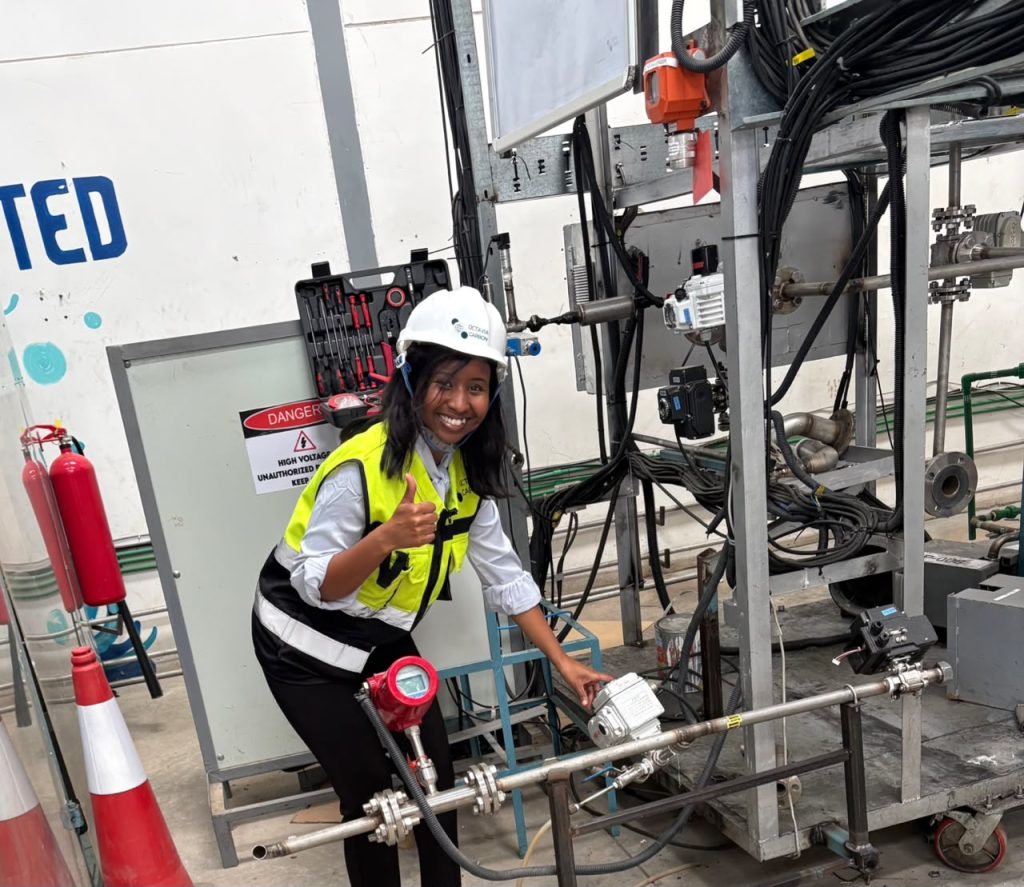
At an international conference not long ago, someone approached Sifa Gakii Kinoti and asked if she could help serve the refreshments. They assumed she was the waitress. “I was surprised,” she says. “I even offered to help them look for the waiter.” She wasn’t there to pour tea. She was one of the speakers. And when she walked to the front of the room and began her presentation, the people who had overlooked her leaned in to listen. It is the kind of moment Sifa has learned to move past quickly because there is far more interesting work to be done.
At just 25, Sifa is Head of Policy and Partnerships at Octavia Carbon, a Kenyan company developing direct air capture technology machines that pull carbon dioxide directly out of the atmosphere. She also serves on the steering committee of the Carbon Removal Kenya Association and is Vice Chair of the Global South CDR Coalition, roles that place her at the centre of a field still taking shape in Kenya, across Africa and beyond. “There isn’t really a blueprint,” she says. “You learn in the process, and from people who have gone before you.” That uncertainty excites her. It also makes the journey harder.
Sifa studied Environmental Engineering at the University of Nairobi. “I’ve always loved mathematics and science,” she says. “I wanted to create sustainable solutions for Africa.” Her path into climate technology was anything but conventional. Unlike medicine, law or accounting, direct air capture is a field few people have heard of, and even fewer have built careers in. There were no clear roadmaps, no long list of professionals to learn from, and few young African women in leadership positions in the field.
Instead, Sifa found herself helping build an industry while building her own career within it. “We’re creating something new,” she says. “That means learning constantly, sometimes failing and always adapting.”
Sifa regularly walks into meetings where she is the youngest person in the room, the only woman, or the only young African. Sometimes those assumptions are never spoken aloud. She still feels them. “It can be intimidating,” she admits. “The people around you have many more years of experience.”
Her response has never been to speak the loudest. It has been to prepare the hardest. Before every meeting, she researches the issues, prepares thoroughly, leans into her strengths and communicates with clarity. The result, she says, is that people stop seeing a 25-year-old. They see someone who knows her work and communicates it with confidence.
Working in one of Africa’s pioneering carbon removal companies has also given her something few others have: perspective. “Because we’re building this from the ground up,” she says, “sometimes we bring perspectives that no one else has.”
Despite her confidence, there is one habit she is still learning to overcome. Sometimes she hesitates before asking a question. “I worry people will think I should already know the answer.” Then someone else asks exactly the same thing. “And I think … I should have asked that.”
It is a small confession, but perhaps the one that makes her story most familiar. Confidence, she has learned, is not the absence of doubt. It is deciding not to let doubt speak louder than you do.
Moving into policy analysis demanded that she master entirely new material. There were meetings where she did not feel ready, documents she read repeatedly, and conversations she listened to more than she spoke. But every challenge became another lesson. “You make mistakes,” she says. “You learn. And then you keep going.”
Ask Sifa where her determination comes from and she smiles. “My parents taught us that you don’t sit and wait for someone to solve your problem. You wake up and find the solution yourself.” That lesson has stayed with her. “So, with the right mindset,” she says, “nothing is impossible.”
She is equally quick to acknowledge the people who continue to support her, her family, her friends, her colleagues and her mentors. “Having a support system is important,” she says. “You need people who walk the journey with you.”
So, what would she tell another young woman interested in engineering, science or climate technology? She laughs. “Why not?” She knows the path will not always be easy. Jobs can be difficult to find. The industry is still emerging. Many young women will enter rooms where they wonder whether they belong.
Her advice is practical: apply for fellowships, attend workshops, take internships, find mentors and ask questions. “No one knows everything,” she says. “So, reach out. You will make it.”
In a field still writing its own future, the young woman once mistaken for the waitress is becoming one of the people helping shape where it goes next.
-

Digital Skills Training: The Key to Africa’s $59 Billion Creative Economy
-
Training Was Just the Beginning: How SLA Is Building a Placement Engine for Nigerian Women
-

AI Didn’t Take Her Job — It Gave Her a Raise
-
The 25-Year-Old Shaping Africa’s Place in Carbon Removal